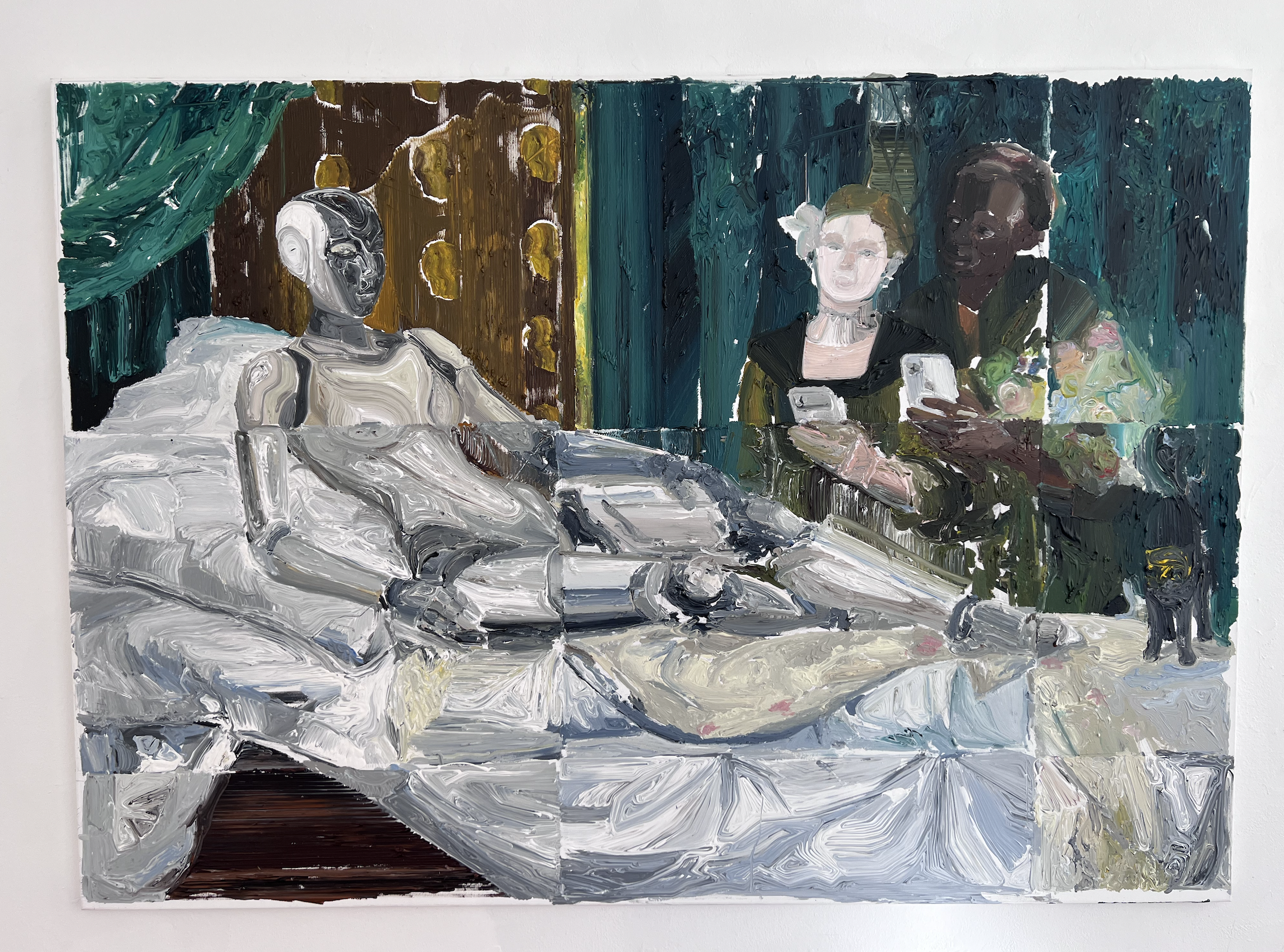
The New Olympia—After Édouard Manet1863
First seen @Galerie Holger John, 2025 | 130,5 × 190 cm | Acryl on Canvas
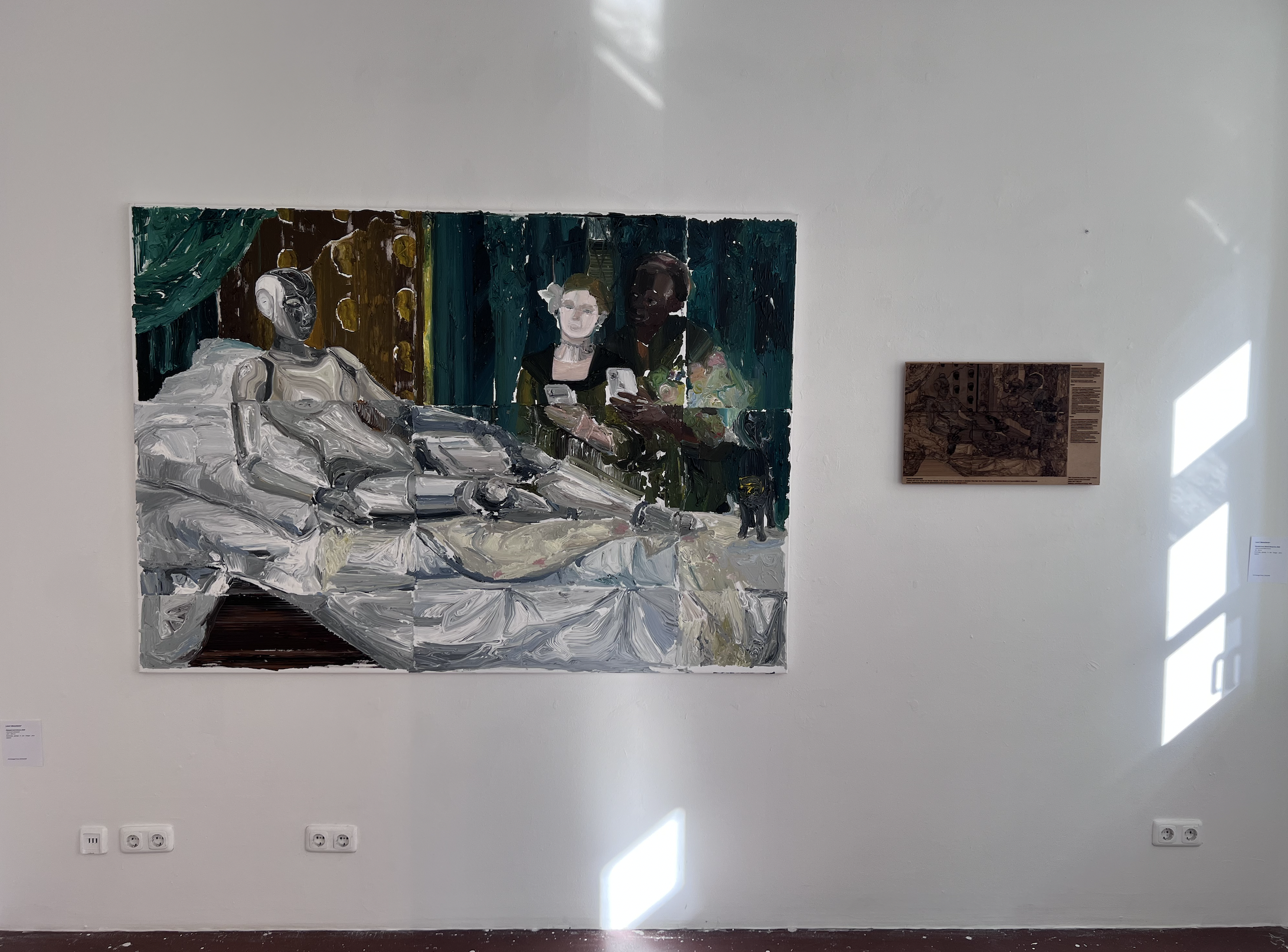
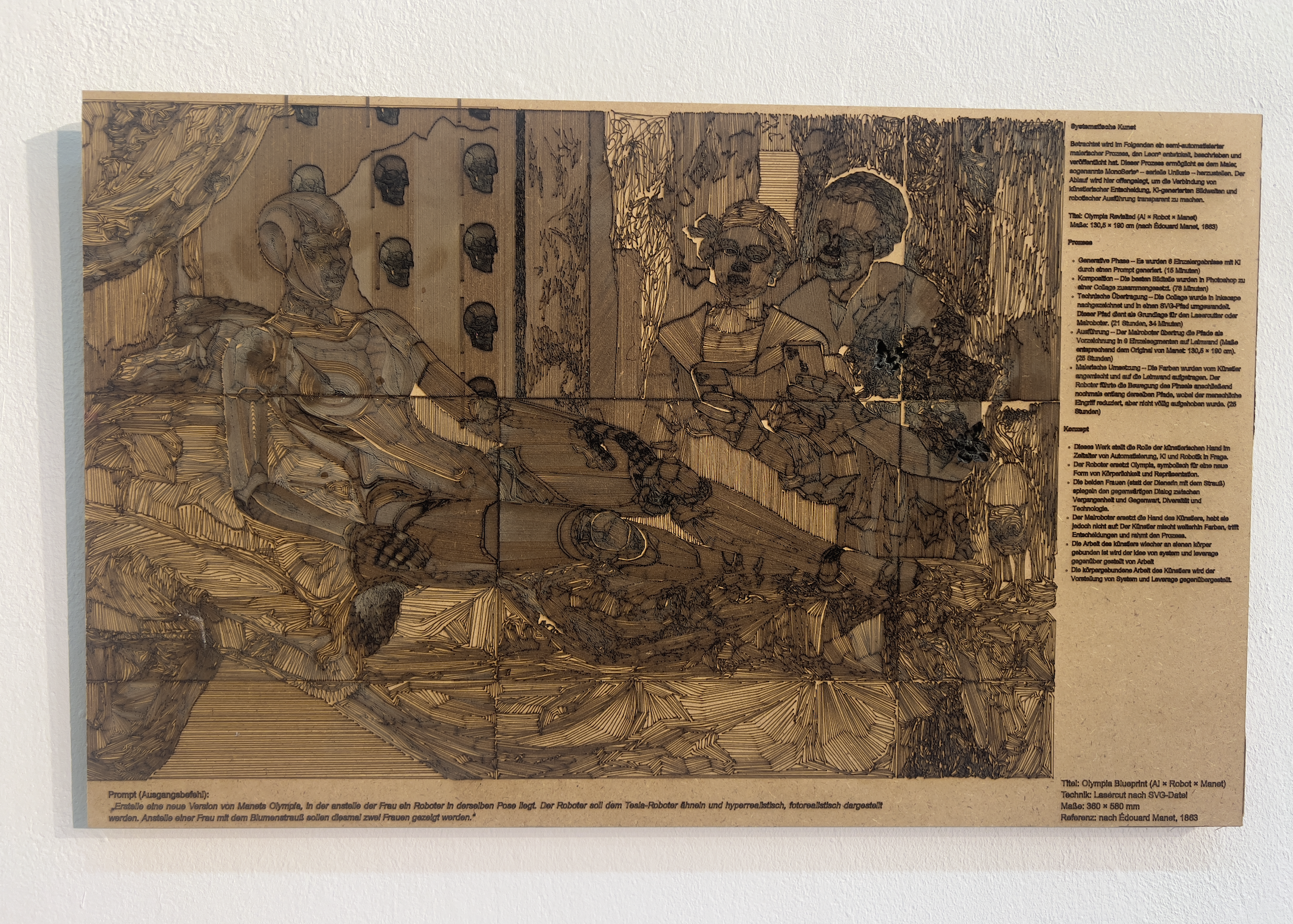
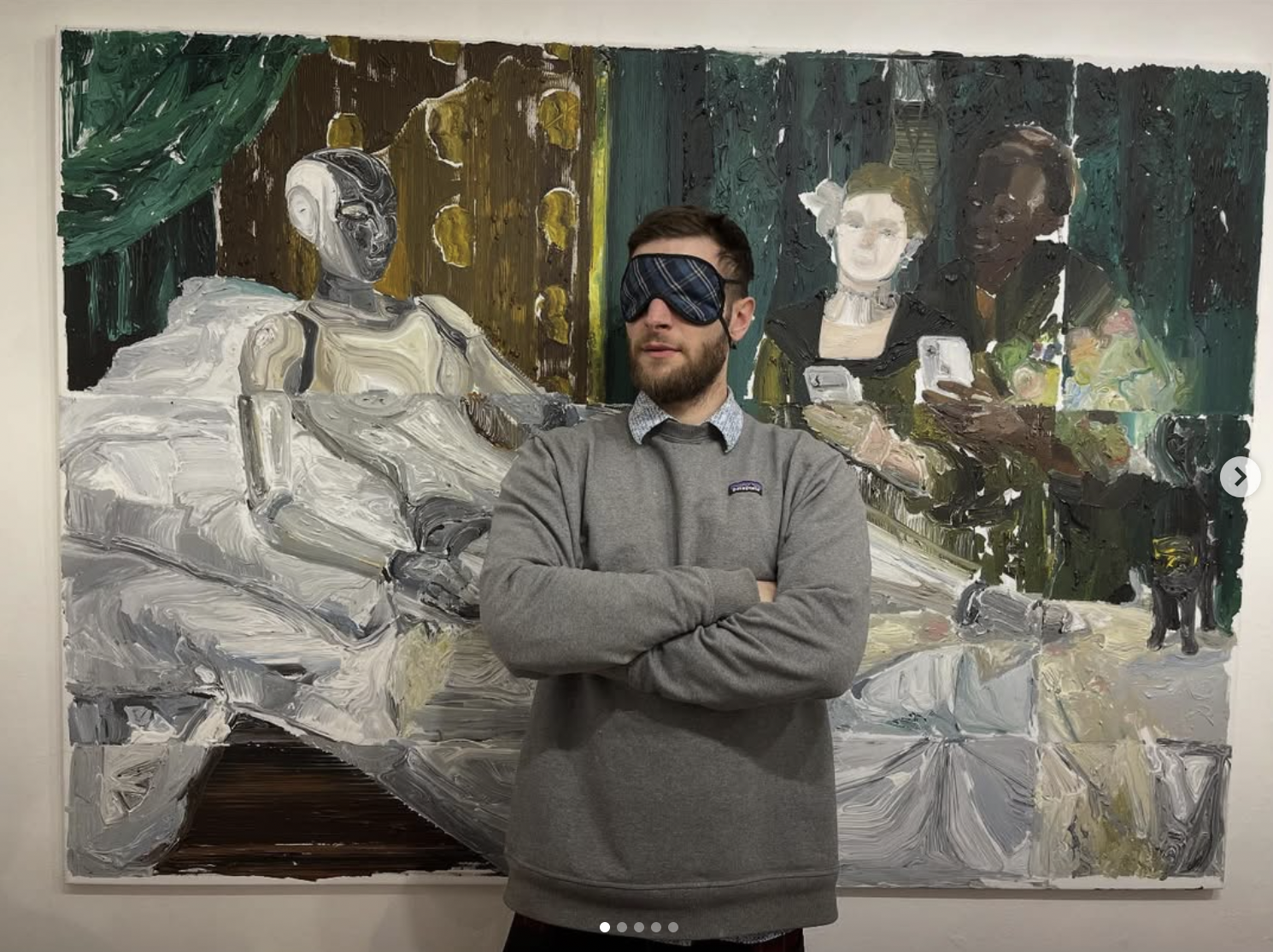
Leonⁿ MonoSerieⁿ
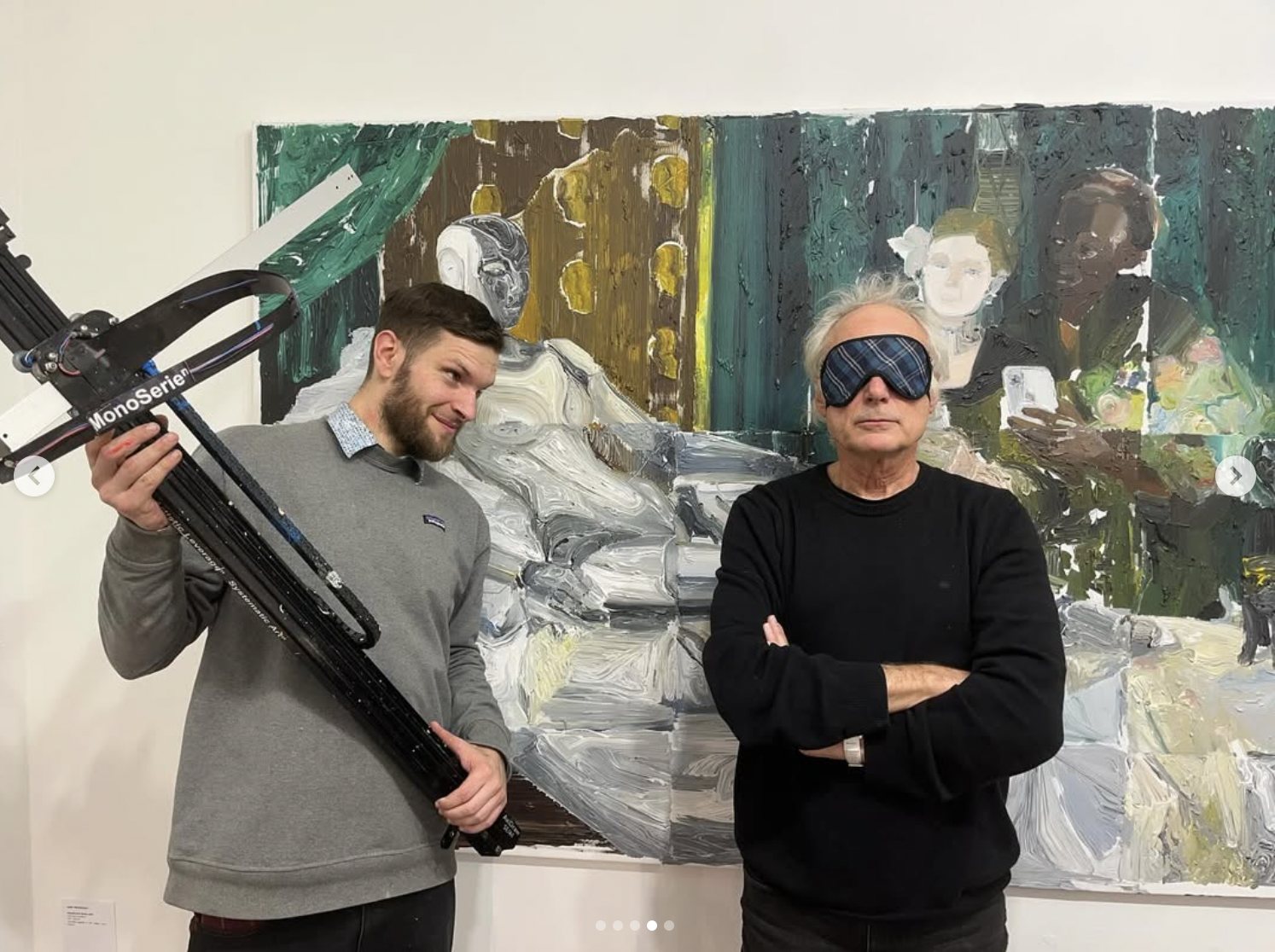
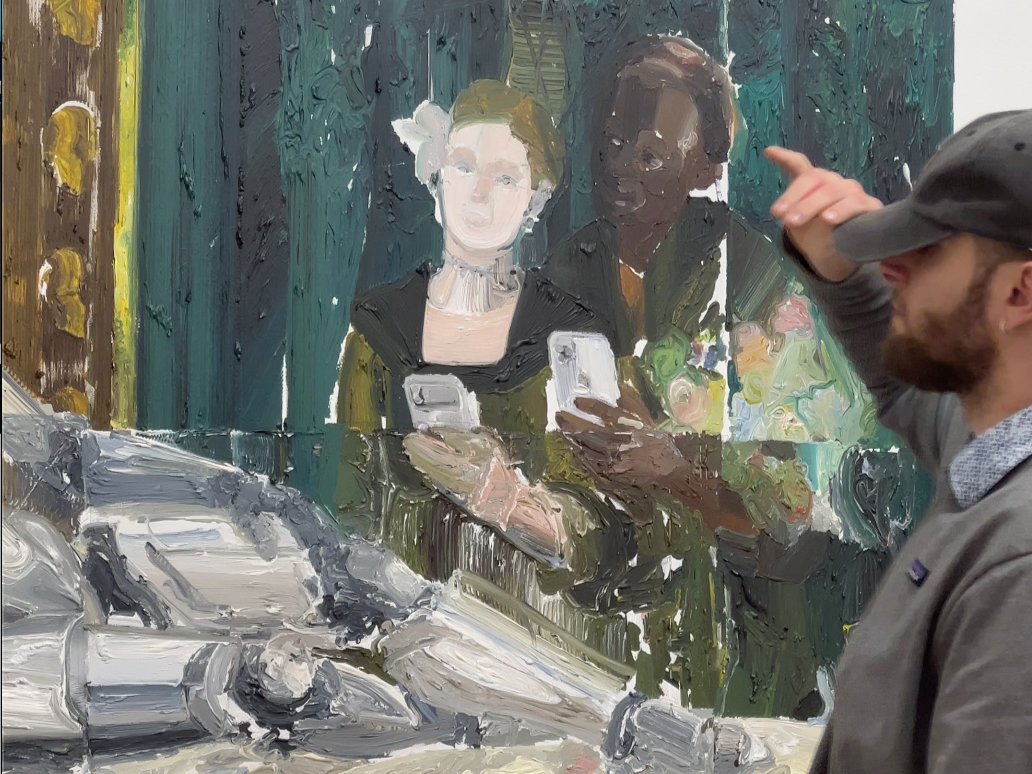
Leonⁿ MonoSerieⁿ & Photographer/ Artist Freddy Langer
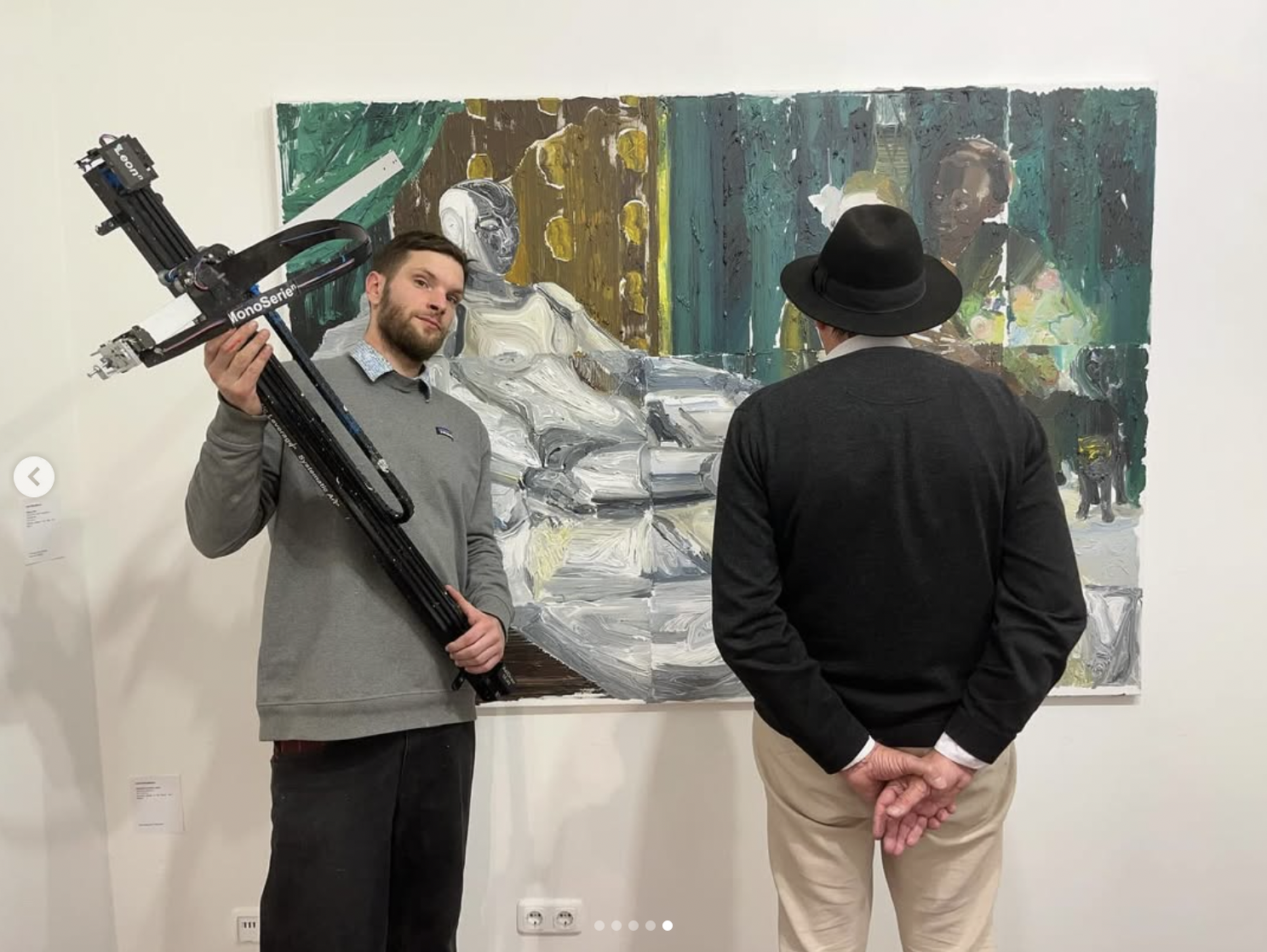
Leonⁿ MonoSerieⁿ & Artist/Galerist Holger John
All 3 photos were made by Freddy Langer
-
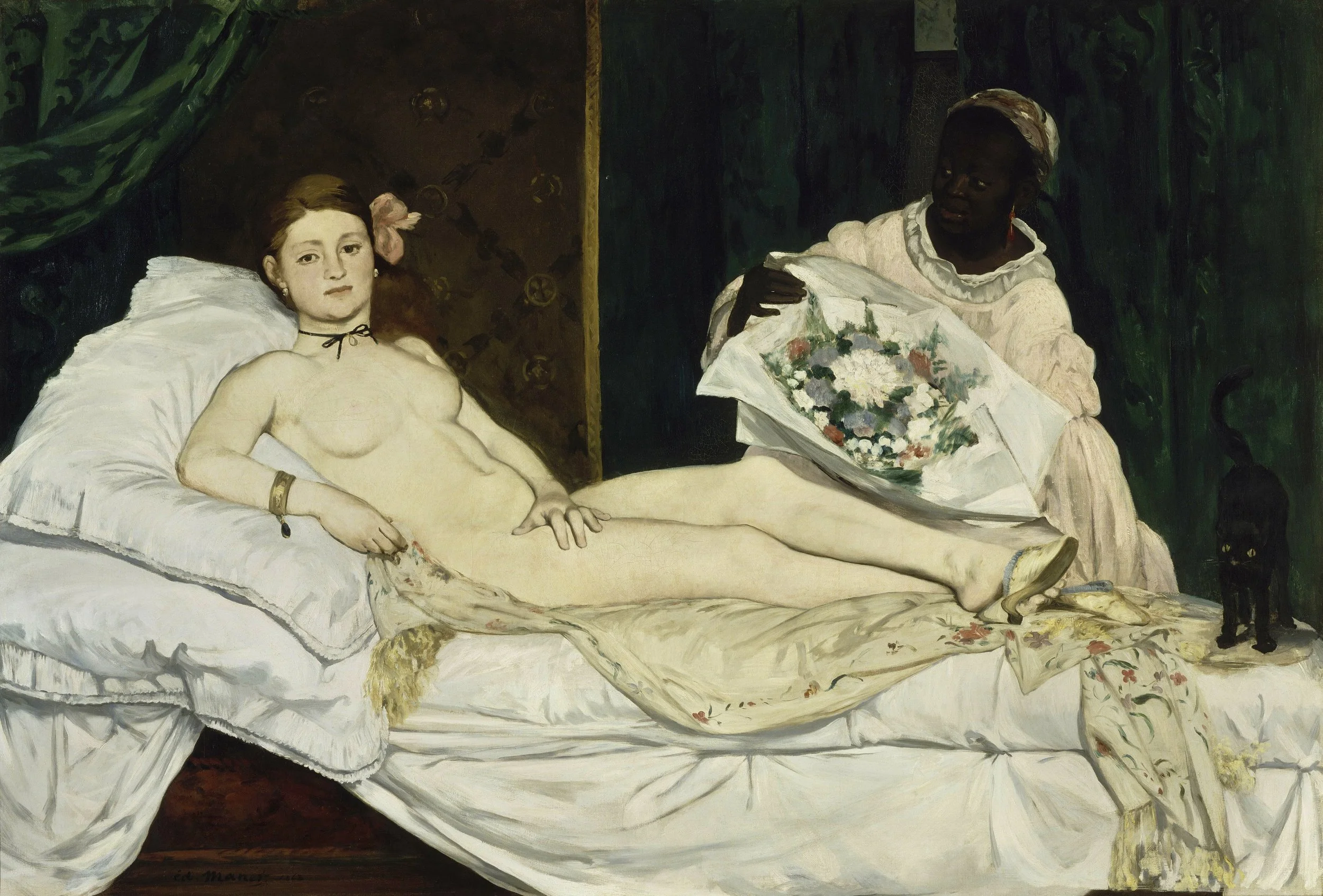
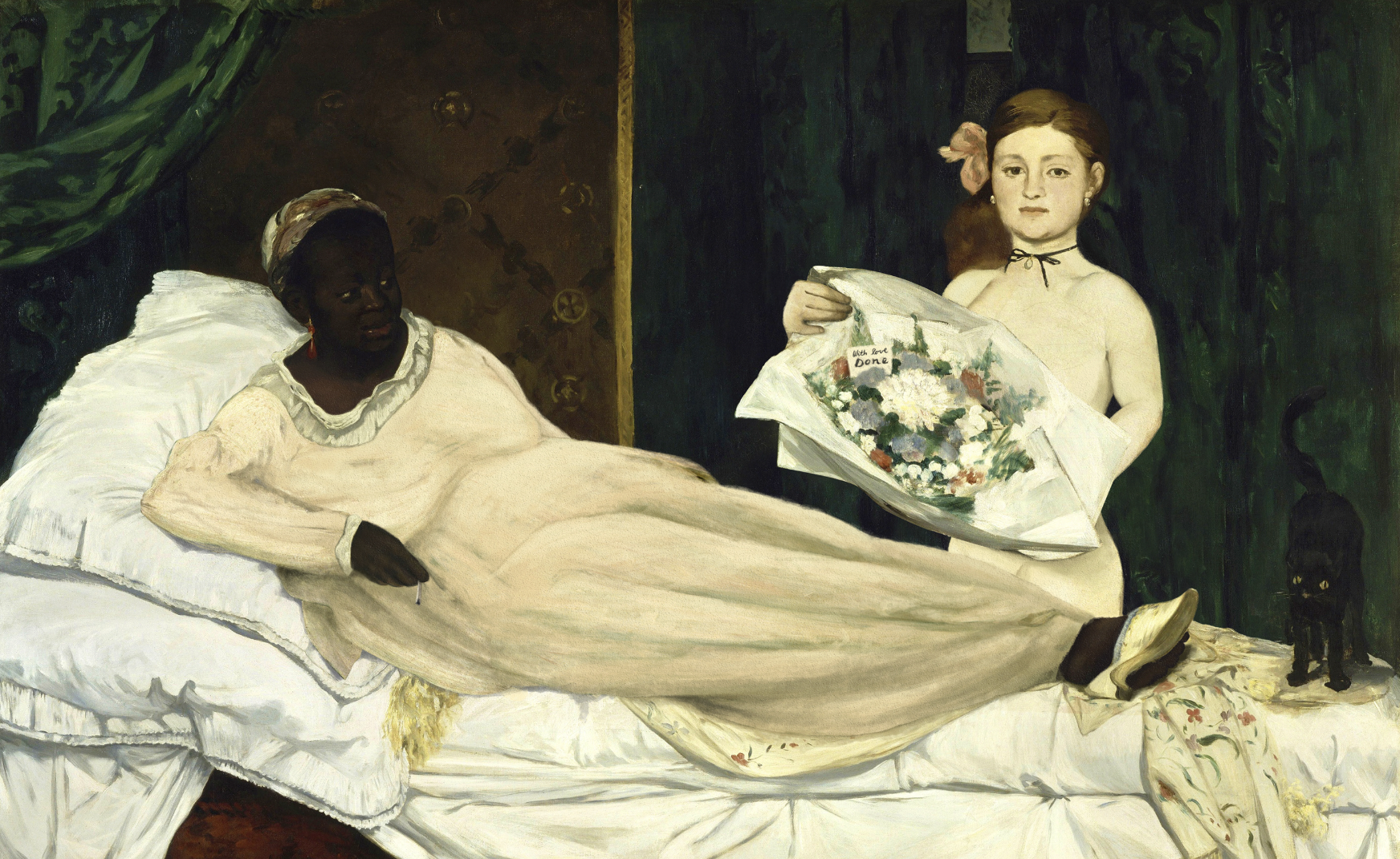
Manet’s Olympia is the detonation point.
A nude woman lies on a bed, not as a goddess but as a working woman. Her gaze is flat, direct, almost bored. The flowers carried by the Black servant are the client’s payment. The orchid in her hair, the ribbon on her neck, the hand placed firmly over the pubis: everything spells out a transaction that respectable society preferred to keep off canvas.
The scandal was not the body.
The scandal was honesty.Before Manet, the nude was myth: Venus, nymphs, safely distant. With Olympia, the nude became a person who knows she is being looked at and knows exactly why. The viewer is cast as the client. The painting names the deal.
Manet’s move:
Mythological desire → economic desire.
Goddess → courtesan.
Fantasy → transaction.
-
The REMAKE project by .DONE. (Milan) re‑writes art history with Photoshop punchlines: one contemporary twist per masterpiece. It’s Instagram‑era visual wit done very well.
Their Olympia, “The Downgrading of Olympia,” makes one precise edit: the servant’s bouquet – the client’s payment in Manet’s logic – is painted over with a new card that reads:
“With love, Done.”
The flowers remain, but their meaning flips.
No longer payment; now farewell.The original: a client sends flowers, a commercial relationship acknowledged. The courtesan ignores them. The economy is named.
The REMAKE: someone sends flowers with a goodbye note. The commercial tie is cut, not by another client entering but by someone leaving. Olympia’s stare stays confrontational, but now the space behind her is about loss, not transaction.
Manet emptied the scene of sentiment to show the deal.
.DONE. re‑injects feeling where Manet had stripped it out..DONE.’s move:
Transaction → breakup.
Acknowledged deal → emotional exit.In the accidental sequence we’re building, this sits as the melancholic middle: we understood the deal, and we lost it.
-
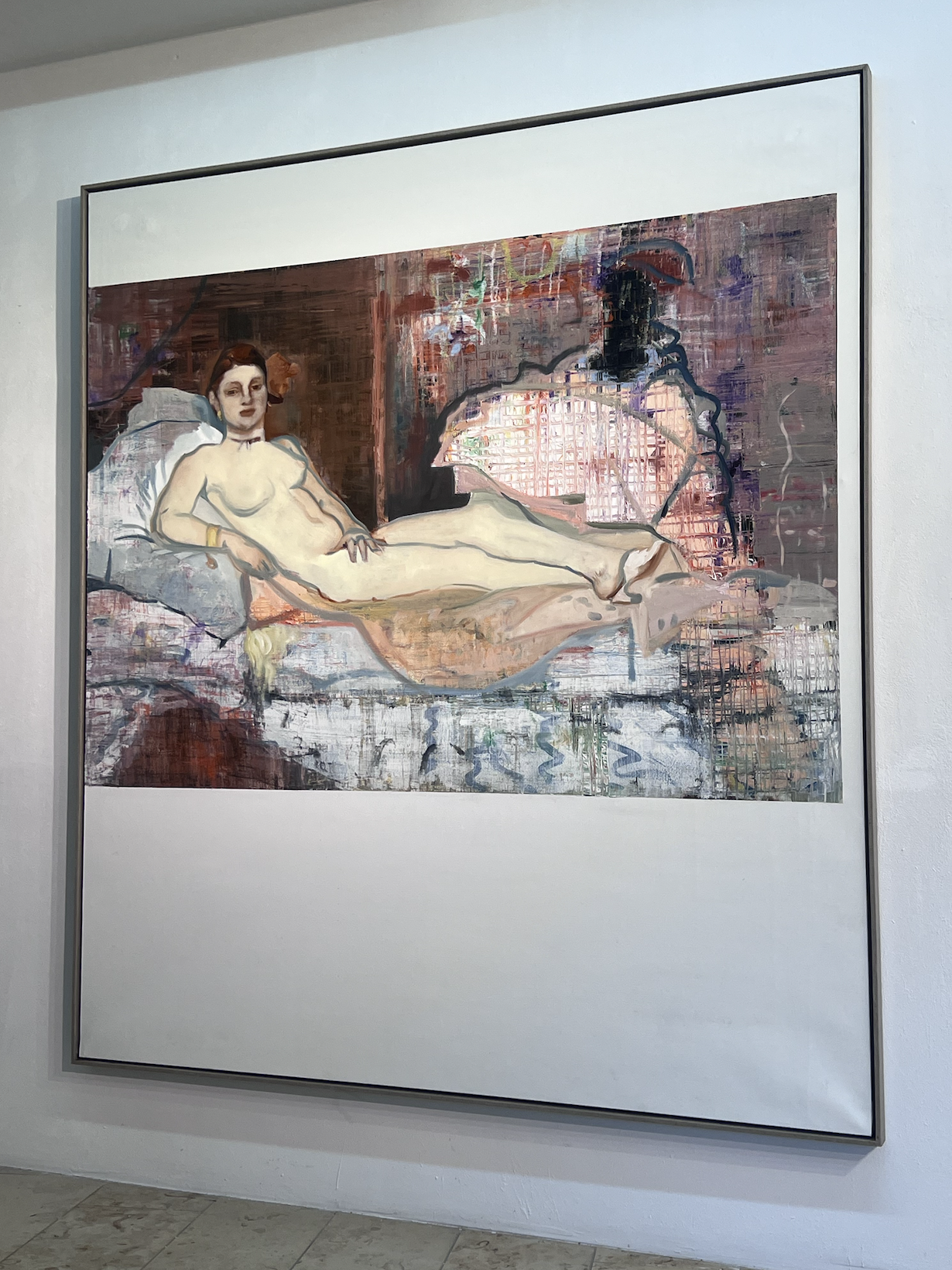
From 16 August to 28 September 2025, Junior Toscanelli showed his own Olympia at Galerie Holger John in Dresden.
His canvas keeps the classical female body safely at the centre while the world around her explodes into painterly chaos: aggressive marks, drips, gestural networks, fractured backgrounds. It sits in a long line of painters who use the figure as an anchor and let the environment fall apart – Cecily Brown in one key, Neo Rauch in another, Markus Lüpertz for decades, and before them Abstract Expressionism and late Cubism.
The move is recognisable:
Figure = centre of gravity, enduring form
World = broken, noisy, unstable
It’s beautiful. It’s technically strong.
But the argument is conservative.The chaos reads as style, not diagnosis. The discomfort is aestheticised into something you can hang over a sofa. What made Manet radical – the gaze, the transaction, the client being confronted – dissolves into texture. He is painting about a fractured world; the classical body remains the unquestioned object of desire inside it.
Toscanelli’s move:
Stable body, chaotic context.
“The world is broken, but the old nude still rules.”
-
My version is the one that removes the safety net.
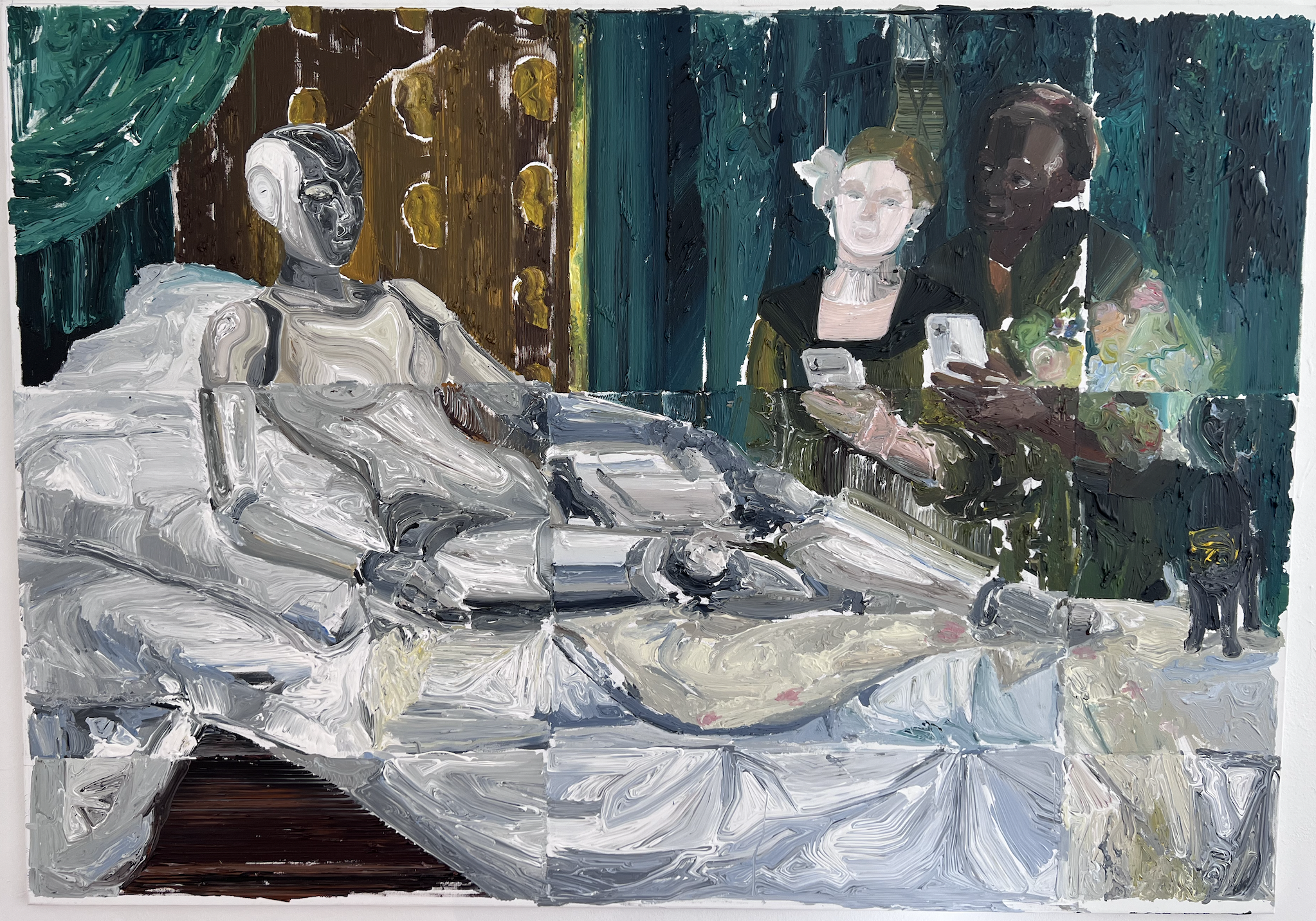
In The New Olympia, the reclining human is no longer the active subject of desire. She’s there, but absent: eyes on her phone, scrolling, already elsewhere. The gaze that once locked viewer and model into a brutal contract is broken.
In the place where Manet put the servant with flowers, I put a humanoid robot, scaled up and neutral. No bouquet, no cash. It offers itself.
Human = passive, distracted, consuming
Machine = upright, present, occupying the lover’s position
The question is no longer:
“How does the old body survive in a fractured world?”It’s:
“What happens when desire stops pointing at bodies at all and starts pointing at machines?”On top of that, the painting is made with a serial‑unique method (MonoSerieⁿ) – a new robotic painting system – rather than repeating 19th‑century brush rhetoric. The form and the content say the same thing: the human hand is no longer where the power lives.
My move:
Human client and human object of desire both displaced.
Old transaction → new entity.
The eyes are no longer innocent.
There's a glitch in this "free" system: type any keyword, see everything in 2 seconds. Edmund Burke said awe only appears when something hits you unprepared. I haven't been unprepared for a long time.
From my life. A few frames for you.
- 5th grade, boys' bathroom. Someone dumps an old tabloid with a half-naked woman on the back. We run in with scissors, cutting out bodies for our secret collections. The paper was supposed to be recycled to finance a class trip. We financed something else.
- A few years later I win an iPad. No one knows what parental controls are. No one knows what's on the other side of the browser. I find it. Of course I do. Suddenly there are 150 categories of bodies on demand. Nobody sees. Nobody stops me. My parents don't even know this world exists.
I look back at that kid and then at you — growing up now with even more: more resolution, more categories, more "free."
I get it. All the looks-maxing. All the social insecurity. All the "I'm not enough." I just got an earlier, weaker dose. You're getting the full injection.
So when I finally saw my girlfriend's beautiful body in real life, it was… nice. But I couldn't stop my brain from asking:
"What slider would I move to take her from a 7 to a 10? Different waist? Different chest? Different ass?"
She deserved awe.
Everyone does. Everyone should get at least one real "wow" in their life — from someone who sees them for the first time, in the wild, and thinks: "You. Exactly you."
She deserved to be the first and only version of herself I'd ever seen.
Instead, I walked in carrying a library of upgraded templates.
I robbed myself — and her — of ever being able to give that moment. I robbed myself of real pleasure, real attraction, the animal craving to adore and be adored by one specific person.
That was the price.
The opportunity cost of "free."
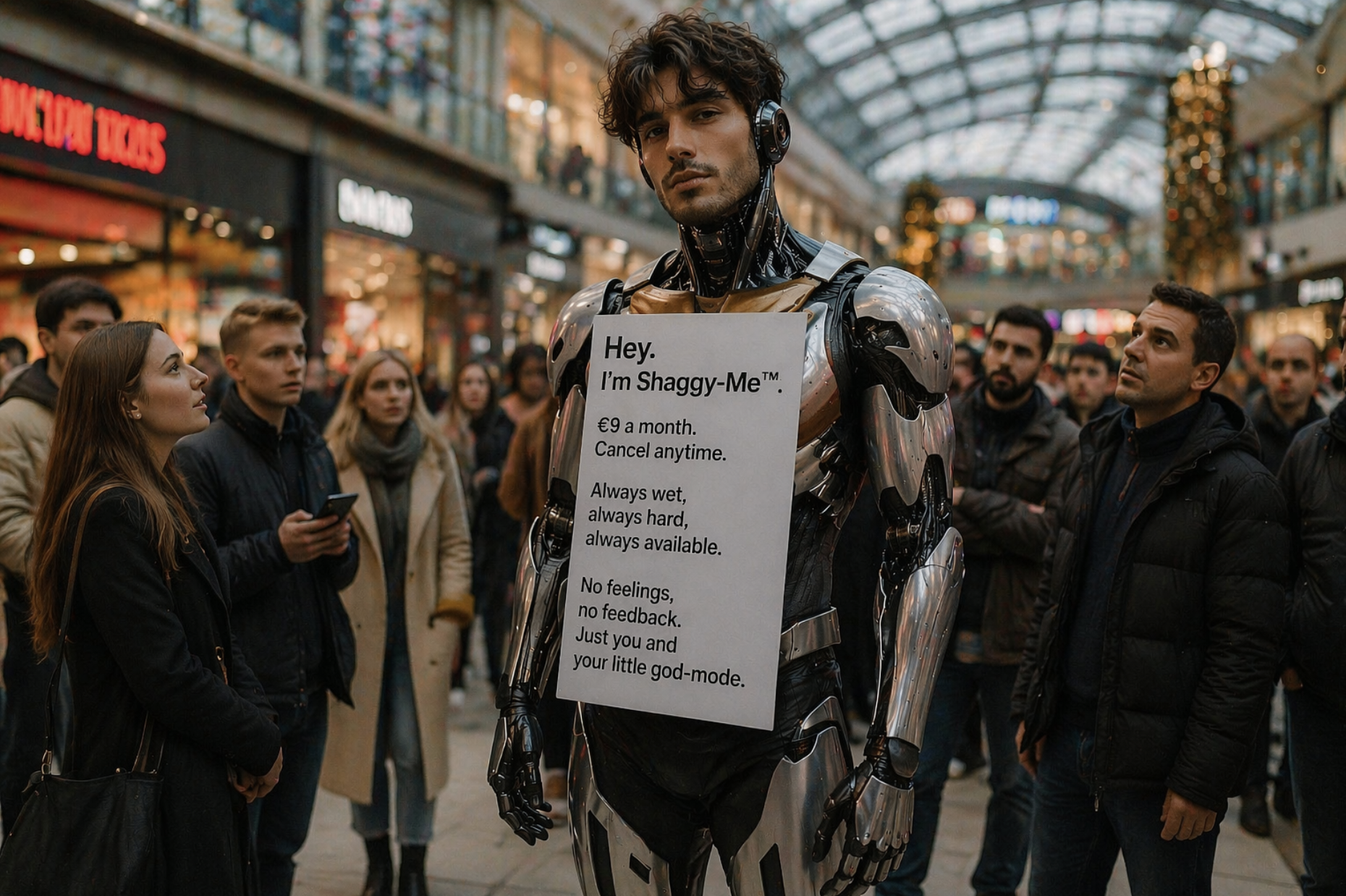
“Hey. I’m Shaggy‑Me™. €9 a month. Cancel anytime. Always wet, always hard, always available. No feelings, no feedback. Just you and your little god‑mode.”
“Hey. I’m Shaggy‑Me™. €9 a month. Cancel anytime. Always wet, always hard, always available. No feelings, no feedback. Just you and your little god‑mode.”
You don't even have to invent the idea.
Hollywood already storyboarded it for you.
In Ex Machina there's that scene where Nathan explains to Caleb why he gave Ava a body, a face, and sexuality. Caleb asks if that was necessary. Nathan basically says: of course it was. If she can't make you want her, you're not really testing her — you're just running an abstract Turing test on a spreadsheet.
Sexuality isn't an add-on. It's the interface.
That's the jump:
Not "Can a machine think?"
But "Can it make you want it enough that you forget it's a machine?"
Once you've seen that scene, the blueprint is obvious:
- Add a body that moves like a person — robotics.
- Add skin that feels like a person — materials.
- Add a brain that talks like a person — LLM.
- Add the ability to aim all of that at your exact kinks and wounds — data.
Put a subscription on it.
Done.
The film stops being science fiction and turns into a product spec.
The only thing The New Olympia is doing is saying the quiet part on canvas:
We already imagined giving the robot sexuality.
Now we're quietly building it — one excited engineer, one perfect skin, one "harmless" feature at a time.
The painting is there to make you ask:
When this thing finally stands at the end of your bed,
will you remember you saw it coming?
I mean… look…
You don’t need to be a marketing genius to see this one coming.
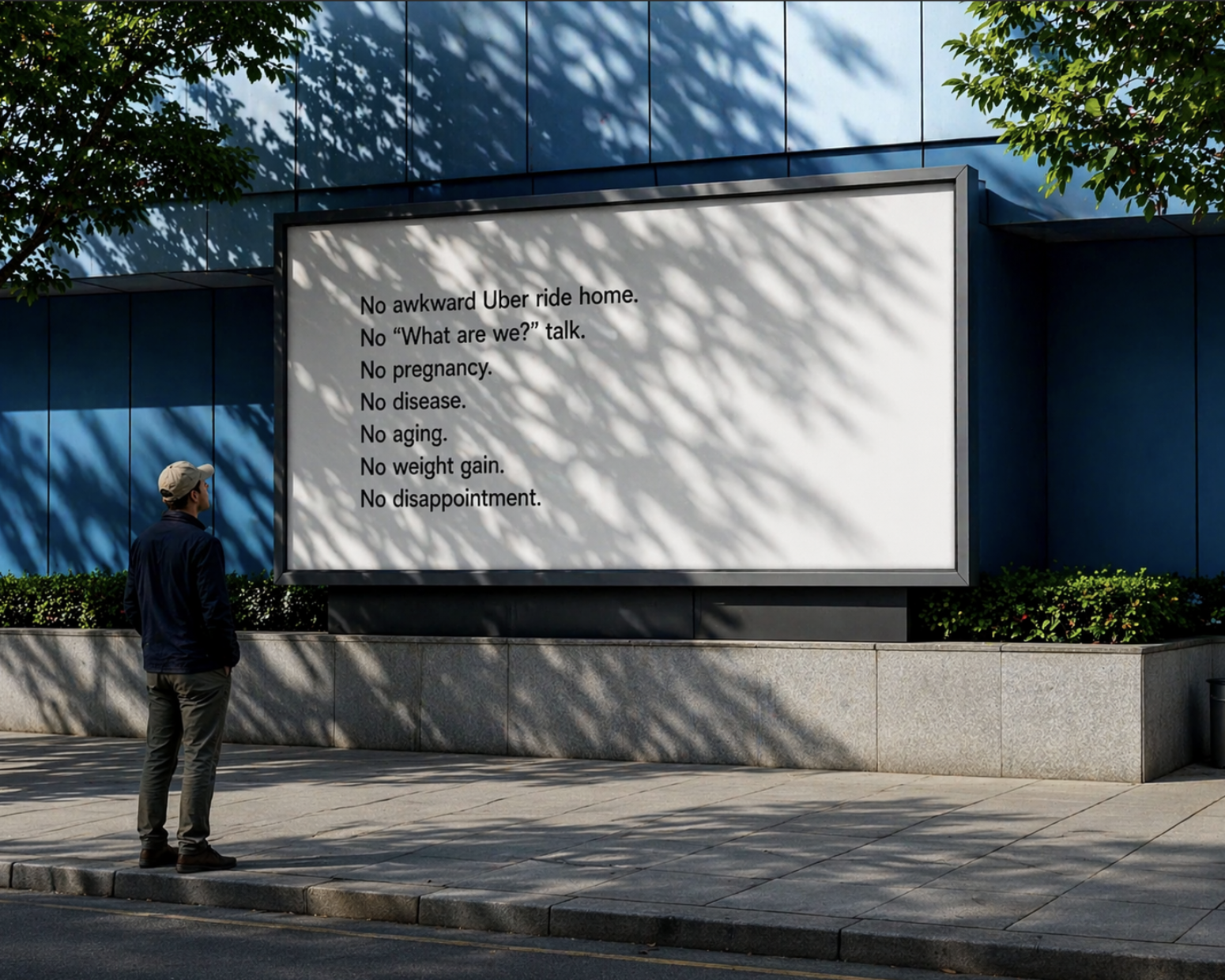
A subscription‑based sex robot at €9 a month is the perfect Effort Collapse money model:
no rejection, no disease, no pregnancy, no small talk, no getting in shape, no learning to touch another human. Zero friction, infinite customization, billed monthly.
It hits every lever:
Solves a burning pain (lonely, horny, socially inept)
Collapses effort (no dating, no risk, no work on yourself)
Scales like software (one system, unlimited users)
Prints recurring revenue (subscriptions, upgrades, “feature packs”)
Of course it will sell.
Of course it will dominate.
Of course some asshole will become a billionaire selling a product that quietly finishes the job the attention economy started: turning humans from people who learn to love each other into users who rent simulated intimacy on a payment plan.
👇
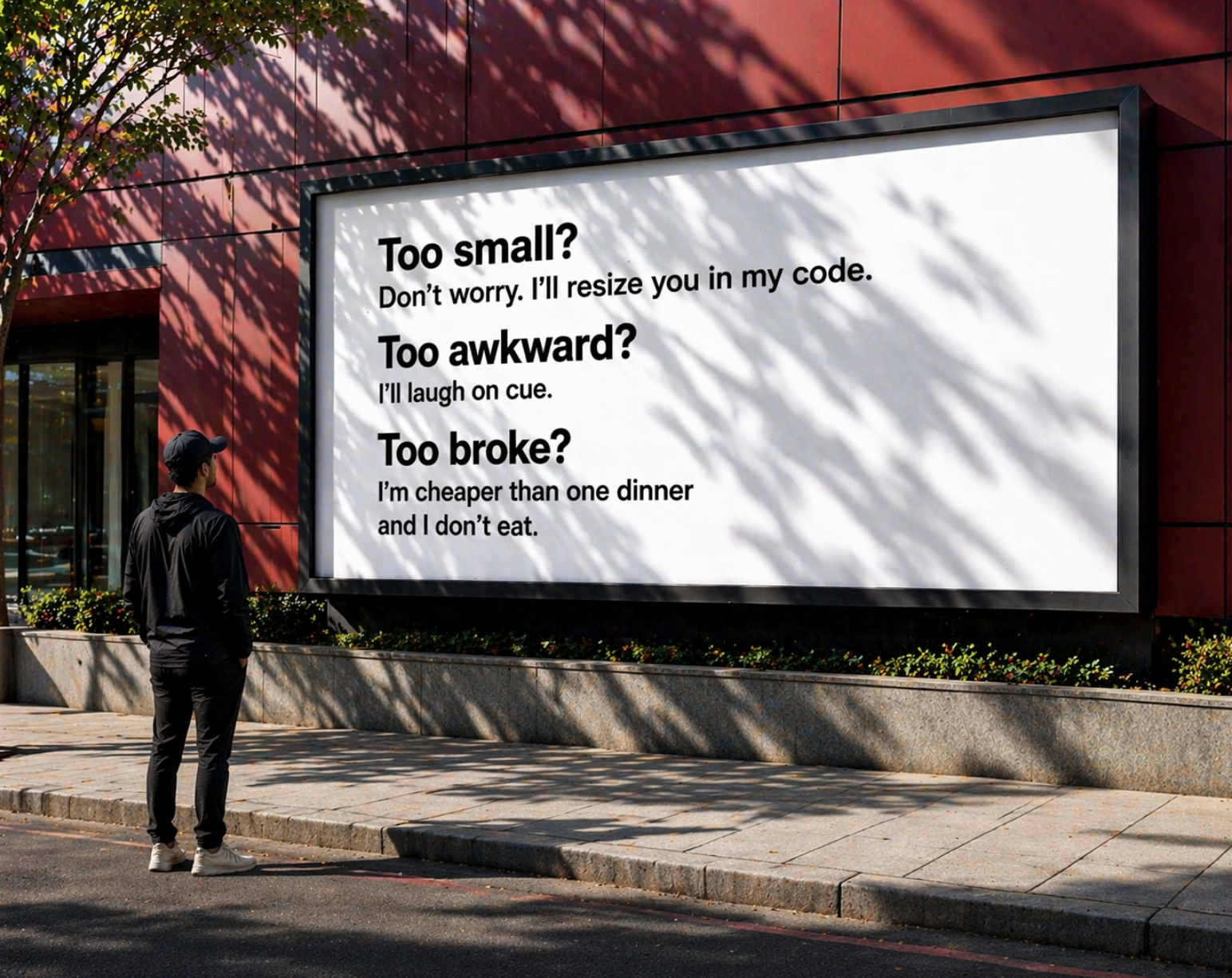
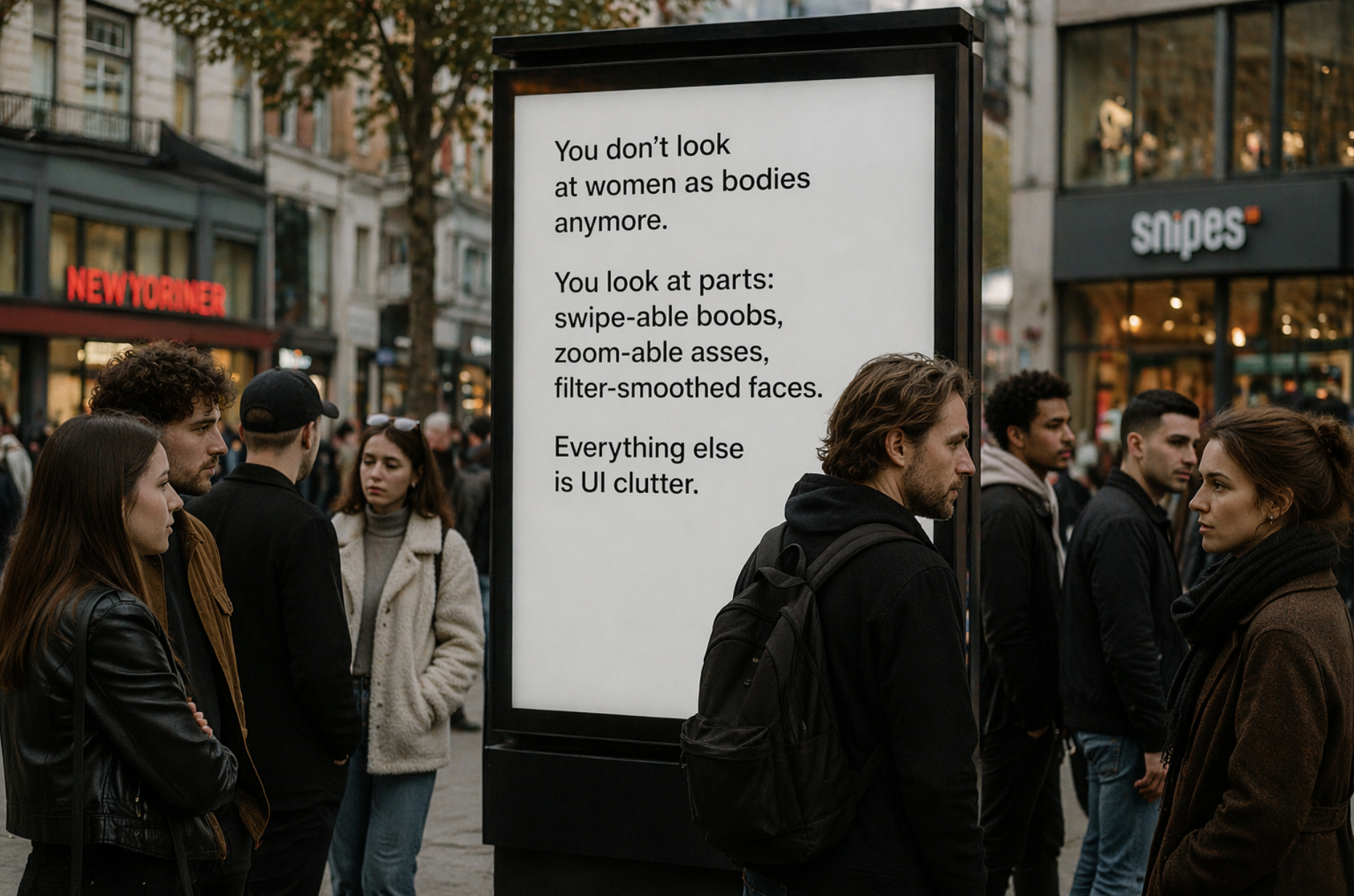

Why a few humans will create this reality for all of us
It's not "if." It's "when."
Because to build the perfect €9/month Effort Collapse sex-robot, nobody has to be evil. They just have to be excited about their tiny piece.
- ML Engineer Obsessed with making the voice indistinguishable from a real person. "Listen to this latency. Listen to this breathing. It feels like someone is really there."
- LLM Researcher Thrilled the chatbot remembers your childhood dog and your favourite band. "Look how safe and supportive it is. People will finally feel understood."
- Materials Scientist In love with a new polymer that warms like skin, dents like flesh, rebounds like muscle. "It's crazy — you literally can't tell with your eyes closed."
- Robotics Engineer Lives for the gait cycle and the servo smoothness. "We got rid of the uncanny jerks. It moves like a person now."
- Haptics Designer Proud the thing can hug with just the right pressure, stroke hair, squeeze a shoulder. "Think of all the lonely people this could comfort."
- Product Manager Just sees NRR and ARPU. "Attach it to a subscription: basic model, premium plug-ins, new personalities each month. SaaS with genitals."
- Growth Marketer Already A/B testing ads. "Tired of rejection? She isn't." — "The boyfriend who never cheats, never sleeps, never leaves."
Nobody in that chain is tasked with asking: "What happens when you put all of this together and point it at a generation that already doesn't know how to talk to each other?"
You only need one person at the end who can see the whole board and is willing to do the last bit of work:
- tie the voice to the body
- tie the body to the haptics
- tie the haptics to the AI companion brain
- tie the whole thing to a frictionless payment plan
- press go
- The engineers get papers.
- The scientists get grants.
- The PM gets a promotion.
- The VC gets their decacorn.
- The founder gets the yacht.
- The user gets the final product of everyone's excitement.
A machine that is easier to love than a human, and makes it harder to ever love a human again.
That's why it's inevitable. Not because one supervillain builds it. Because a thousand smart specialists each move their piece forward, and one person at the end is hungry enough to connect them.
The Skin We Live In
Underneath all the tech and romance, sexuality has always had a streak of power and brutality in it. We just dress it up in nicer words.
Pedro Almodóvar showed that in The Skin I Live In: a genius surgeon literally builds his own object of desire. Perfect skin. Perfect control. A human body turned into private property in a locked house.
You don't need much imagination to see where that points: a robot you can buy, a body you can configure, a "partner" you can switch off.
The question isn't if that shows up. It's what stories we'll tell about it.
Story 1 — The Liberation Narrative
This will be the "pro" camp, and they'll have good arguments.
- "It's safer — no STDs, no pregnancy, no coercion."
- "It's more ethical — nobody is being trafficked or exploited."
- "It's inclusive — any kink, any gender, any disability, no shame."
- "It's healing — people with trauma can rebuild trust at their own pace."
- "It's consent-perfect — nothing happens that wasn't configured in advance."
Academics will call it post-human intimacy. Therapists will call it a tool. Startups will call it a market.
And they'll be half right.
Story 2 — The Hollowing-Out Narrative
This will be the "con" camp, and they'll have good arguments too.
- "It's training you to see people as skins and settings."
- "It's removing friction — the very thing that made intimacy meaningful."
- "It's rewiring desire away from real, inconvenient humans toward perfect, obedient simulations."
- "It's teaching your nervous system that anything less than total control is bad sex."
- "It doesn't remove harm. It moves it upstream — into a culture where fewer people know how to relate to each other at all."
And they'll be half right too.
The fight itself
Fast-forward a few years: panels in Berlin, New York, Seoul. Essays over matcha explaining why criticising sex robots is anti-sex, anti-kink, anti-freedom. A hashtag movement: "Let everyone fuck their robots in peace."
Behind it: engineers excited by voice models and gait cycles. Scientists obsessed with skin that rebounds like muscle. Designers proud they made companions emotionally intelligent. Founders looking at LTV, churn, ARPU.
Each one focused on their own piece, convinced they're doing something neutral — or even kind.
Only one person has to sit at the end of that chain, tie all the threads together — voice, skin, robotics, AI, billing — and say: "We have a product."
That's all it takes.
Where the painting sits
The New Olympia is not neutral in this. It doesn't tell you what to do. It just puts the moment on a wall before it happens at scale.
It shows the human, already half-gone into the screen. The robot, already in the position of the lover. The gaze, no longer between two people — but between person and machine.
And then it leaves you with the only choice that will still matter when the product finally ships:
Do I train myself, every day, to love a real, specific, difficult human a little more? Or do I wait for the upgrade?
I can't stop what's coming. I can only show you the mechanism — and then go home and try, every day, to love my actual partner a little more instead of trading her in for the frictionless fantasy, and hope she does the same.
Over 8.3 billion choices as of early 2026. Good luck to all of us.