I’m a Leveragedⁿ Artist from the graffiti trenches who uses robots and serial‑unique painting as small labs to make Effort Collapse and emotional economies feelable for real humans.
I live and work in the Effort Collapse Economy – I think, write and build for a more-than-human-world where systems and categories do the hard work and people shape them through design thinking.
Short Progression
1996 – Born in Ravensburg, Germany.
Age 13 – Starts spray‑painting at SPIKE in Dresden and discovers large‑scale walls as his medium.
Age 16 – Registers his first mural painting service as an official business.
Age 17 – Paints a 25 × 4.5 meter wall piece in three days alongside Slider, each taking one full side of the wall and signing it with their name.
Age 20 – Completes a 12‑meter‑high mural on the facade of his former secondary school in three days, working from scaffolding with a colleague.
Age 21 – Begins studying Fine Arts, painting under Prof. Ralf Kerbach at HfBK Dresden.
Age 22 – Paints commercial murals for private clients and businesses and advertising businesses across Germany, getting paid to learn while working alongside his mentors.
Age 23 – Starts designing mural concepts for Jens “TASSO” Müller.
Age 24 – Paints further large walls in Auerbach with Jens “TASSO” Müller and develops photo‑realistic spray‑can technique.
Age 25 – Ends his career as a muralist at its local peak due to lack of sustainable business perspective.
2022 (25) – Joins the YETI Dresden entrepreneurship scholarship, deepening design thinking and leadership skills.
Age 26 – Spends five months in Australia and, after returning home, begins 16 months of living and working without a fixed address, often sleeping in the YETI Dresden HQ office.
Age 27 – Joins Painting class of Prof. Christian Sery
Age 27 – Develops the MonoSerieⁿ method at YETI Dresden.
Age 28 – Completes his art diploma at the HFBK Drese inside the main room of the Oktogon Dresden, “Emotional Capital”, paints 2,300 serial unique works, publishes a new serial artistic method and defines his own painting style.
Age 28–29 – Travels for five months through Vietnam, Thailand and Kuala Lumpur with his partner and learns “vibe coding”.
Age 29 – Continues his practice at the HoBB.
Sacrifice:
When I was 25, I was a photorealistic spray painter and muralist, painting alongside my mentors, several Bandits Dresden members, and Jens TASSO Müller. I’d started that path at 13. By 16 I’d registered my own business. I’d painted for TESLA, Amazon, and others.
On paper it looked great.
In reality I was 10 kg overweight, always tired, broke, and completely directionless after corona.
At 26, I did the thing most people never do – but many will be forced into by AI:
I left my community, my friends, my mentors, and the career I’d built behind.
I had a skill, but no solid foundation. No real “substrate education.”
So I climbed back down, re‑educated, and re‑assembled myself.
I joined YETI Dresden, got a scholarship for entrepreneurship,
and learned design thinking so I could stop being just “talented”
and start becoming someone who actually builds things that last.
Money:
I know how it feels to have 5k.
I also know how it feels to live five days on 3.45€ and be hungry.
Now I understand: the substrate layer always informs the presentation layer.
If I want to force as many creations as possible into existence on the visible, visual layer, I have to protect the invisible layer underneath: cash, tools, stability.
So I treat every euro with respect.
I’m grateful for everyone who covered my bills while I had to learn.
I chose to have no nice clothes, no proper home, and sleep in the YETI office for 16 months rather than have no money to invest. Every cent went into material, into projects that turn into assets and proof. That’s all I want to own.
I need a backpack and the next opportunity.
Give me a tool, a laptop, a platform, a crowd, a mic –
I’ll find a way to make it work.
Think Big:
In just five days – more precisely, in 27 hours and 28 minutes – I painted 2,300 serial uniques (10 cm × 10 cm).
That is around 200 works more than Vincent van Gogh created in his entire life.
Builder:
I spent at least 16 months binge‑consuming content across platforms, so it was only fair to invest 16 months building something of my own: MonoSerie (serial unique paintings). As a YETI Dresden fellow I used design thinking to develop it as an offline system that lets you consume, use, and reflect on system ownership and the principal–agent relationship inside systems you didn’t design but still move in every day. It helps you see where you’re being used for free, and where there’s an uneven cost–gain ratio you can flip to your advantage. If you want the deep dive, look up my art diploma project Emotional Capital – MonoSerie is the core of it.
Voice:
My voice is shaped by economic art philosophy, a doer’s mindset, and an obsession with leverage. I read and write heavily, build systems in the real world, and translate between art, economics, and work so people can see and use their unfair advantage in the market.
Grit:
My mentor Hans Hochkeppel told me he sees one thing in me: grit.
The will to stick it through.
Ask him. Ask Felina Fan, Thomas Kirchner, Alex Grots, Manu Böhmisch, Adrian Menzel, Christian Weise.
They’ve seen what I do when I commit.
As a youngster teacher wanted to brand me as unteachable.
Don’t tell me I can’t do something.
I will work, quietly and for a long time,
and one day I’ll prove you wrong about me
and you’ll read, you missed the opportunity, again,
to be part of it.
Mindset:
I was totally incapable of seeing my fine arts diploma (in 2025) as an asset when I was still in the starving‑artist mindset (2017-2022). It was just a thing to ‘get done.’
When I learned about entrepreneurship, I stopped thinking like a student and started thinking like a leveraged artist.
I used the Oktogon to create and sell a new kind of painting, all on tape.
On top of that, I gave away 1,000 copies of my own 24‑page printed catalogue with the full MonoSerie blueprint inside.
In it, I named, framed, and claimed a new category of art: Leveraged Art – built on a new method that lets artists create serial uniques.
I claimed my tiny piece of art history in a proper academic, historically relevant place,
under the dome of the “Zitronenpresse” in Dresden.
Quality:
I painted a remake of Manet’s Olympia (1863) using a robot.
In my version, a humanoid robot takes the place of the human – a new entity, new sexuality, new desire – and the human becomes the one watching.
It’s a portrait of the tension of our time: who is object, who is subject, and what happens when machines step into our most intimate images.
The piece was first shown at Galerie Holger John in my exhibition
Mensch, KI, Malerei from 03.10.2025 to 13.10.2025.
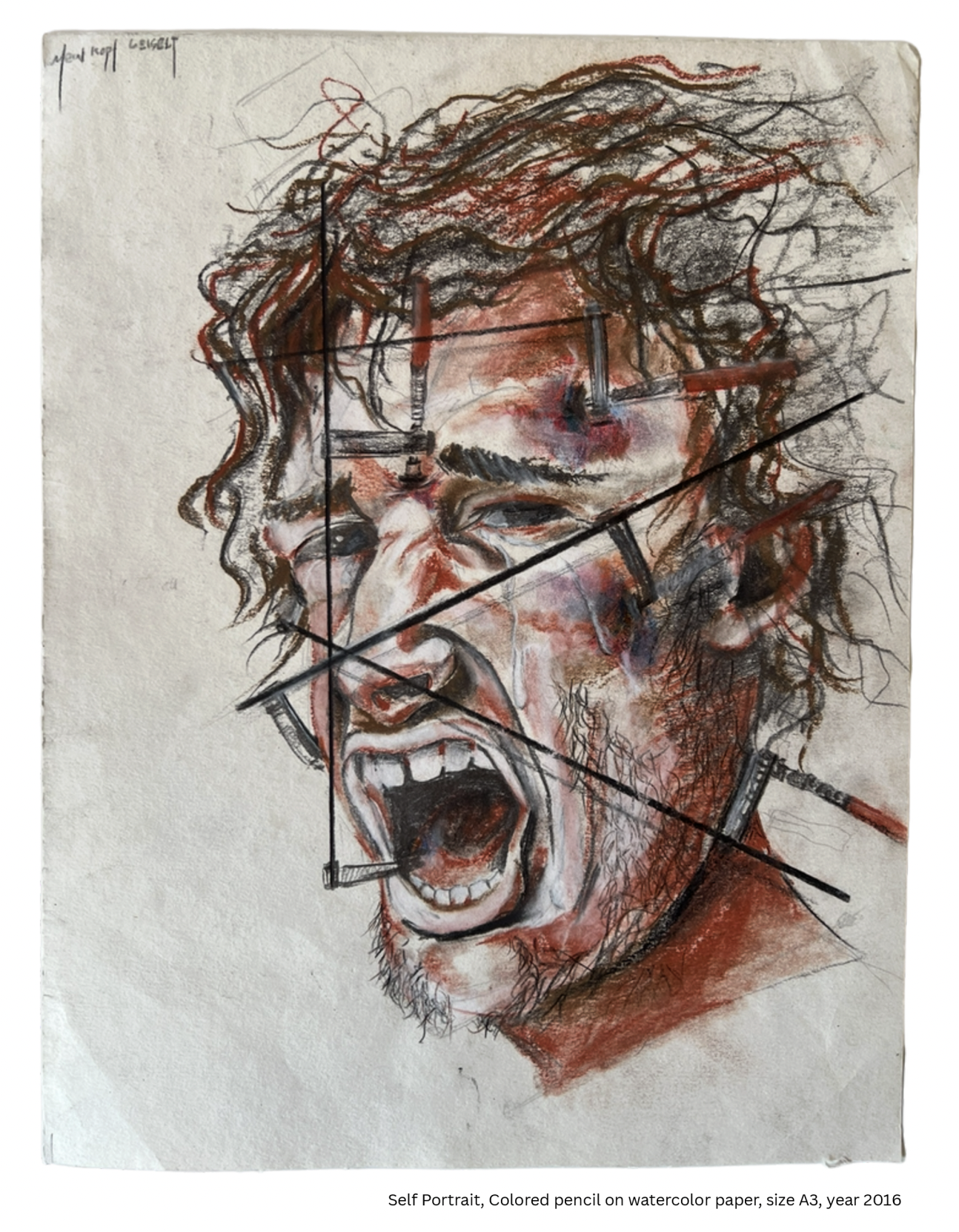
2016 - Self-Portrait
Scars:
I’m a kid of the boomer generation.
Which basically means I’m patch‑worked together a few times over – my therapist says I probably had multiple traumas.
My caring mother did a good job, but you need a team to get 100% right.
She just tried to find love after it was stolen from her when my father got sick. It was misfortune. They were deeply in love. Everyone has the right to search for love.
Anyways, the price was my emotional safety growing up.
So I became hyper‑sensitive. I read people and emotions like books. I educate myself in every field I can. I have to. It’s survival. Being good with emotions is my survival strategy.
I want to be part of something. I want to belong.
What I really wish for is a sandbox other kids invite me into:
“Come play. Bring your shovel. Bring your ideas.”
And I’ll show up with all of it – shovel, basket, plans, unlimited energy – as long as what we build together is exciting enough to escape boredom for a while.
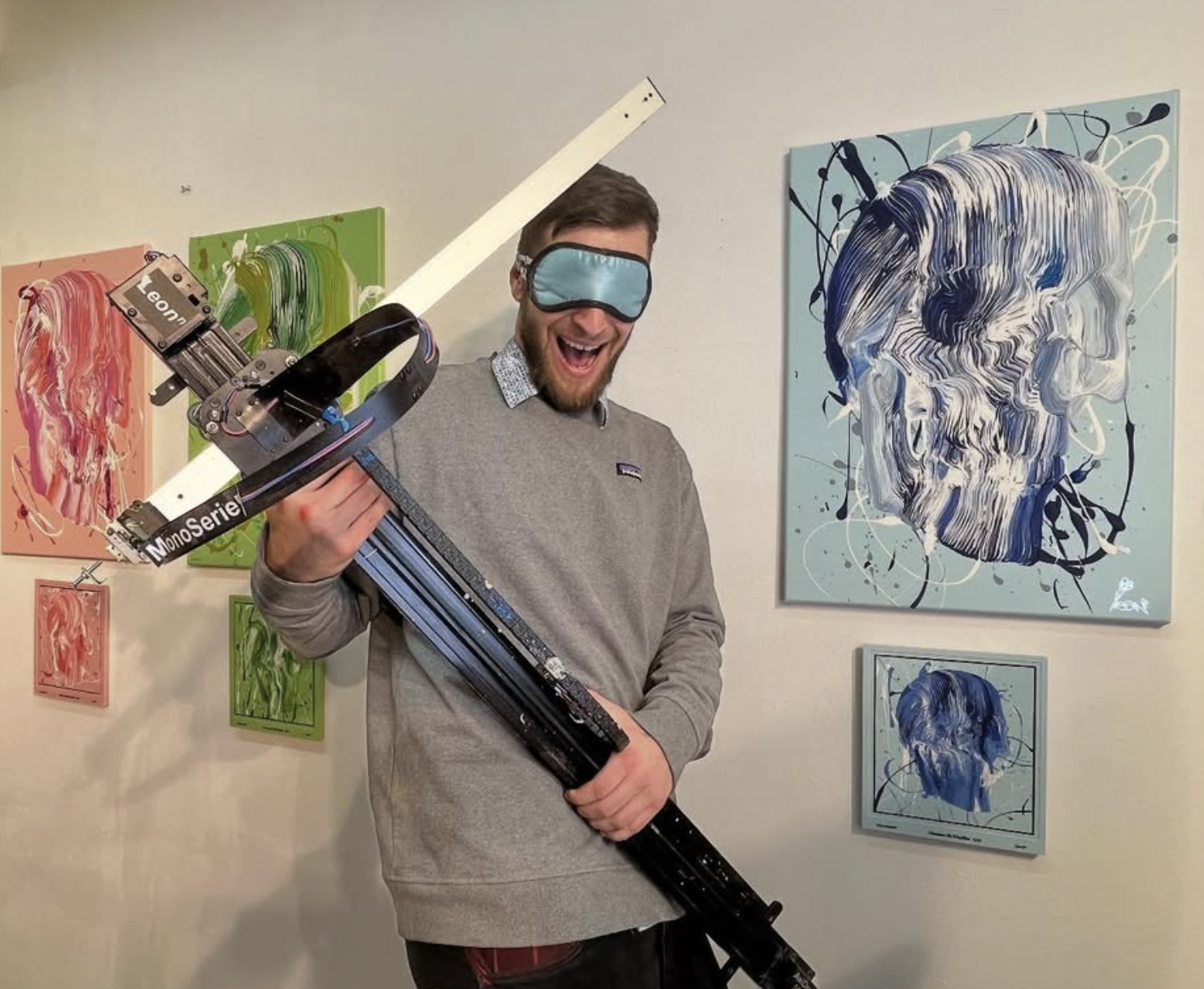
2025 - Self-Portrait