The difference between pain-tings and paintings
is the operating system you're running.
“The quality of your decisions depends directly on the quality of your thinking. The quality of your thinking depends directly on the quality of your information.”
— Shane Parrish
Self Portrait. Colored pencil on watercolor paper. A3. 2016. "Geiselt"
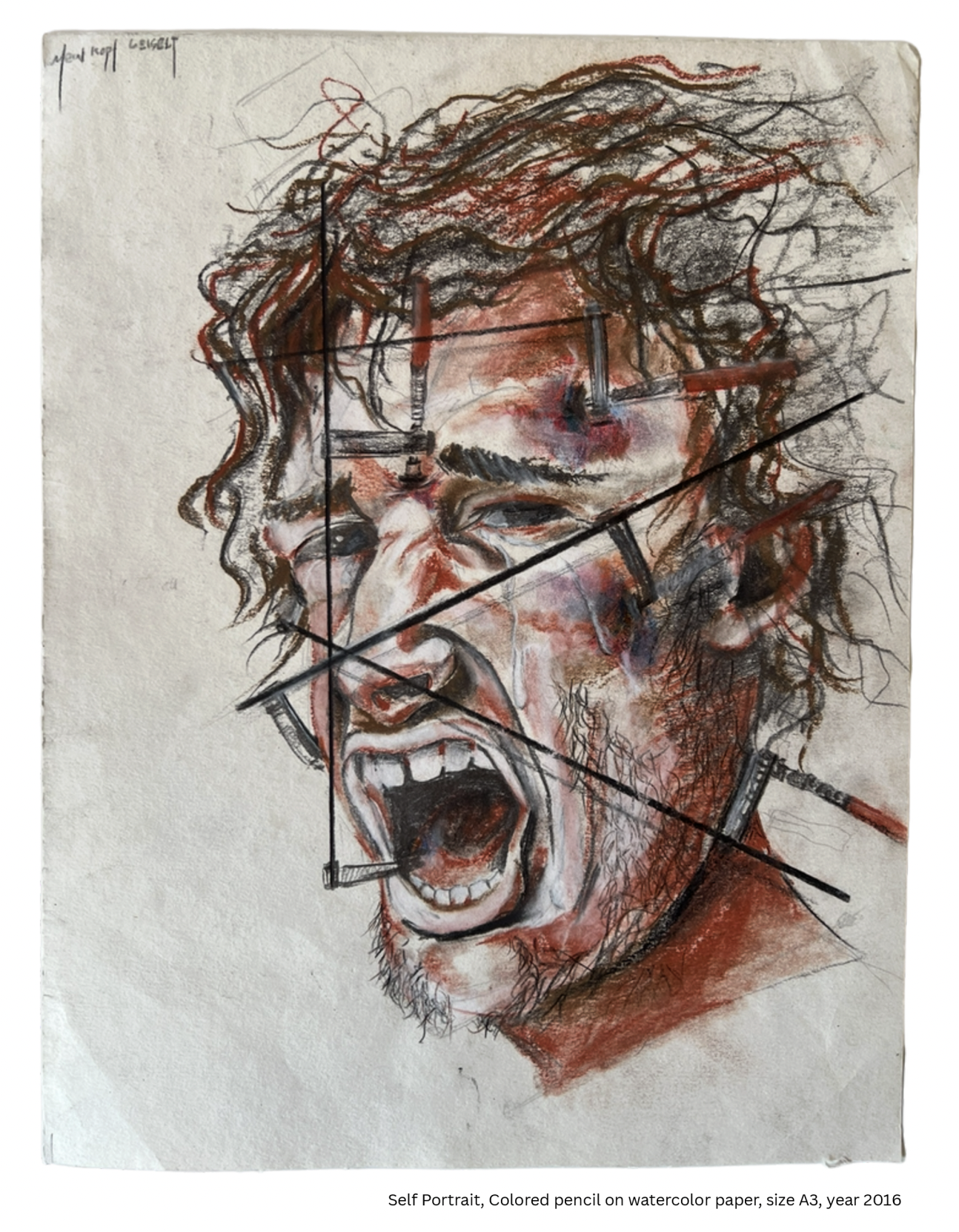
I was born in 1996.
In 2016, I was this:
Wet cement. Traumatized. Fucked up. Rebellious.
I entered art university like that. It was right that I went. And it was wrong that I went the way I did. What came out was a full‑speed crash into the wall. I had to rescue myself.
The first chapter in an artist’s life is not “find your style.”
It’s: survive yourself.
Most never do.
Now you understand why I fight the “starving artist” myth so hard.
When I say I want to kill it and replace it with an honest choice for you and for me, you can believe me this is deeply personal.
Art schools let you run in any direction and call it “self‑exploration.”
The truth: I disappeared for months. Panic attacks at home. Sleeping next to my ashtray and piss bottles under the bed. The room was trash.
No one cared.
I had to rescue myself.
I still went out spraying. Took jobs here and there. That kept a tiny line open to the world.
After my girlfriend left, all I had left was curiosity.
The way back was hard. I was at zero. I know what emotional zero looks like.
Now I also know what economic zero is. I was only able to visit that place later because I was emotionally stable enough to survive it.
If, back then, I had been both emotionally and financially destroyed at the same time, I don’t think I’d exist today.
11 years. Hard work alongside Incredible people
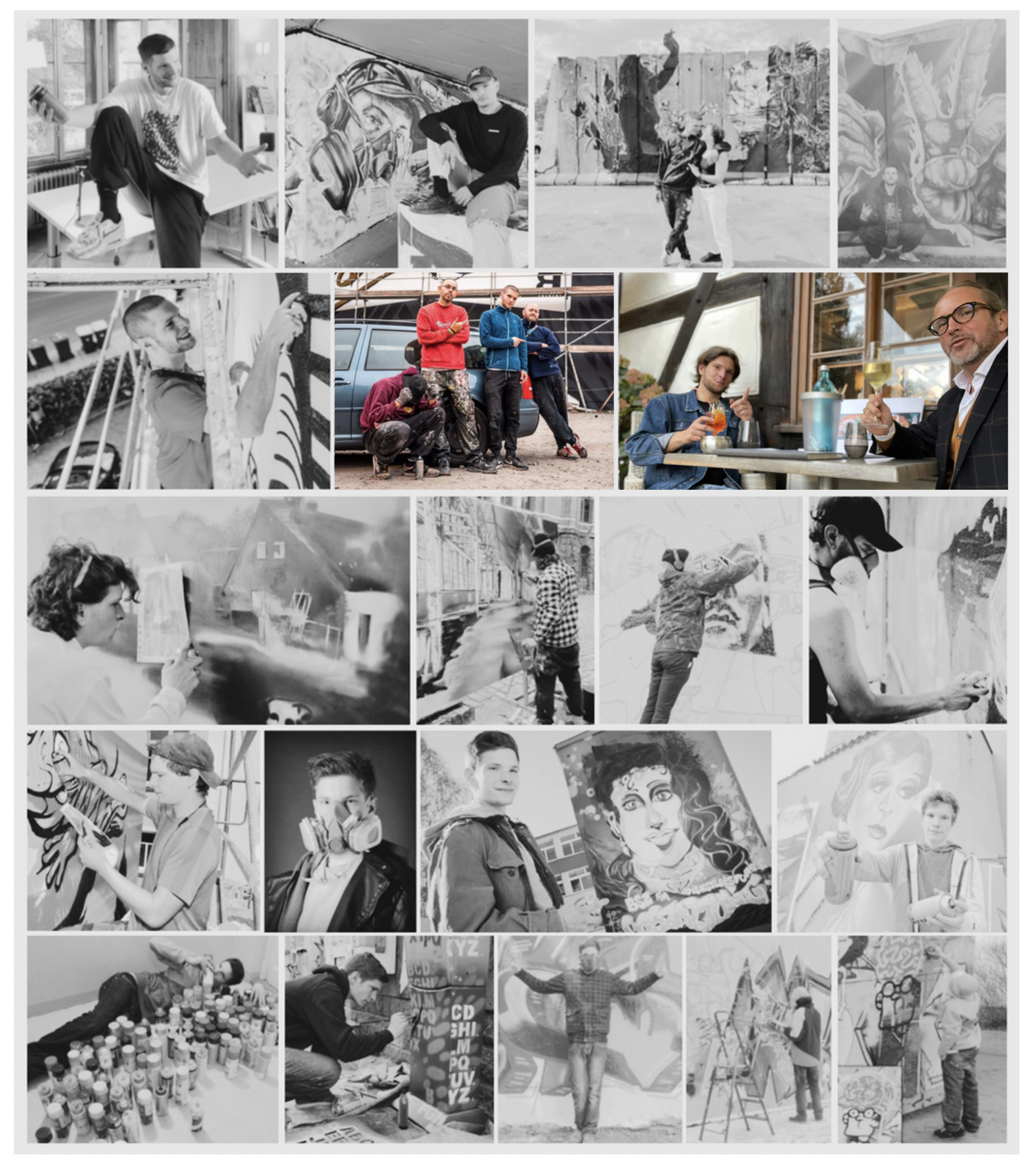
I tasted sweet fruits I could only reach by standing on tall shoulders.
I had everything because of my mentors: the best schools, big projects, good money, the hunger and chance to paint alongside masters. Then I burned all the ships. That’s not “reading a quote about sacrifice,” that’s living it. I wasn’t ready when I needed to be. I had to accept that reality and take different action. The window closed, and I chose not to scale the problems or hide behind hope and optimism.
I’d been in a premium position and got more than my share of benefits. That meant I owed more than mediocrity. On top of that, I had too much insight and data to keep pretending. Building on a broken foundation only leads to a bigger collapse. Sometimes you have to destroy everything to build something that can actually last – armed with the hard‑won experience of how not to do it.
I burned the ships at a time when I was still welcome to stay.
I recommend canceling the career while the sun is still shining.
The climb down will be hard. The climb back up will be hard too.
But that way, the choice was yours.
You had agency.
And because it was your decision, you’ll have the grit to get through it and survive it, no matter what.
The world owes me nothing. You play the cards you’re dealt. But you can always re‑play them, at any moment. A glass can be half full or half empty, pal. That’s how it is for me.
What price will you pay one day?
To Real to Be Seen as Real
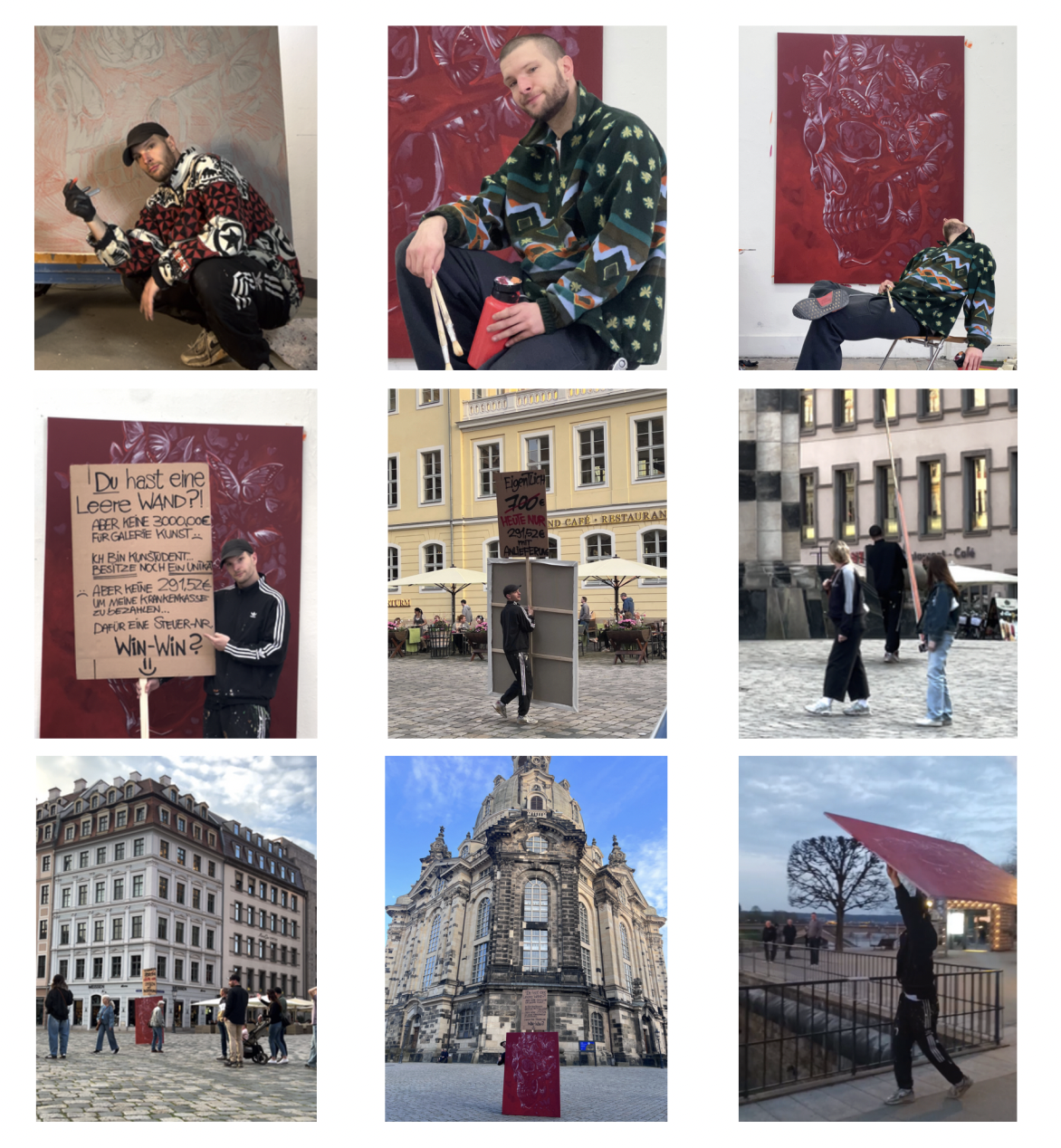
I was €1,345.67 in debt, uninsured, and standing in front of “Frauenkirche” with a canvas bigger than my future.
I held a handwritten sign. People laughed. I had become so fluent in the language of art that my emergency was indistinguishable from a performance.
That wasn’t a personal failure, it was a structural one: the starving artist doesn’t die from neglect, he dies because his suffering has been made beautiful enough to ignore.
Nobody Calls the Ambulance for the Artist
There was only one artist at HFBK Dresden who ever truly broke me.
We were in a room full of people – professors, students, drinks in their hands – and he was naked, wearing a mask, a big pipe fixed in front of his mouth. On the table: a pill, a glass of red wine, a razor blade. He breathed hard through the pipe, then poured the wine over the pill and began cutting his own body, which was already covered in scars. The cuts were deep. He started bleeding everywhere. It was horrible. 30 minutes? I couldn’t walk away. Someone was filming. Nobody called an ambulance. A professor left. Afterwards, I broke down crying in my girlfriend’s arms. Even writing this now hurts.
I still ask myself if Guido needed help that night.
The fact that nobody could tell the difference between a scream and a performance shows how far this can go: no matter what medium they choose, artists are expected to live permanently on the edge. The sentence I heard most was, “You chose this path.”
Did I? People don’t understand that once suffering becomes aestheticized, the system stops seeing a person in need and only sees material for a show.
The tape recorder wasn’t neutral that night. It was extracting Guido’s emotional capital. He used his own body as raw material to get something “on tape,” to turn pain into an art asset – putting his nervous system into emotional debt so that someone else, behind the camera, could end up with the advantage. He was exploiting himself in real time, and we all watched.
“Insert Deep Thought Here”
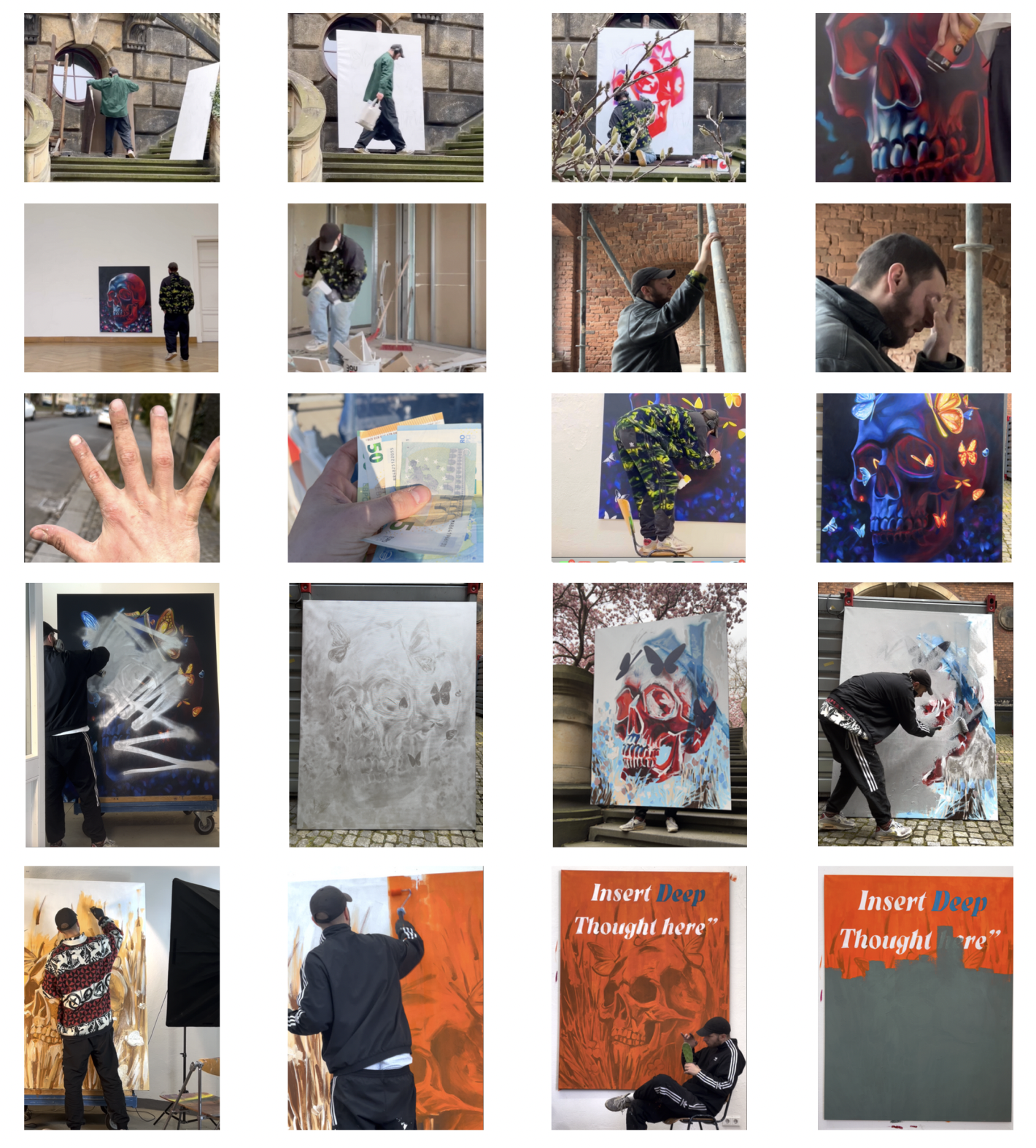
You spend another five hours in the dream-worker cycle.
Doing what you always do – painting what others only wish they could.
You feel superior.
You’re stuck.
And you don’t know it yet.
You follow the feeling.
Yesterday it all made sense.
Today it’s all pressure.
Stress. You need money.
So you make the “brave” choice:
You take a job again.
You trade time for cash in work that drains your energy, eats your health, and buries your potential.
At work, the thoughts spiral all day:
You hate the job.
You hate being misunderstood.
You hate the position you’re in.
Worst of all, because of all that hate, you start to hate yourself for being there.
You work, and work, and work a bit more.
You lose respect for yourself, for your people, and for the simple fact that you do have the power to change your own circumstances.
People exploit you and your position.
When the money flows back in, everything seems fine again.
Years can go by like this.
I chose a different path.
I found the courage to expose my inadequacy – to turn my failure into an exhibition.
I leaned into brutal pattern recognition and made the hardest move:
I climbed down from the wrong hill and started over in the opposite direction.
What I saw from the bottom was simple and violent:
Uncommon actions are the only way to create uncommon results.
This lesson didn’t come cheap.
It cost me comfort.
It cost me pride.
I had to do this. I needed this. I had to reflect.
Just for a chance. Not a guarantee. Just a chance.
Will you dare it again – or are you done?
Why I’m going to kill the starving artist inside me and build you a weapon to kill that myth in your life too – before it turns into a wrecking lifestyle.
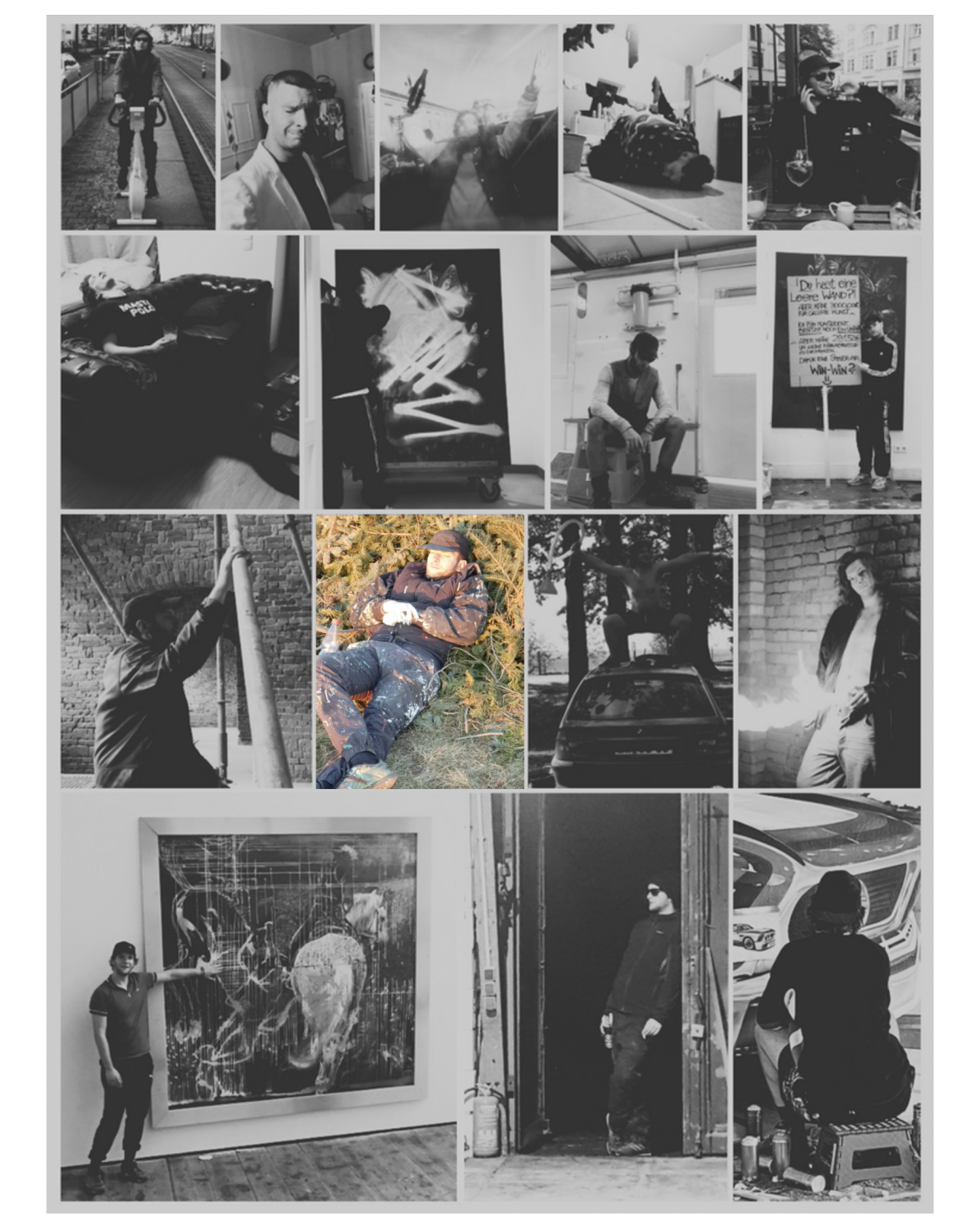
Four years after giving up my mural career, I finally received my art diploma in 2025.
By then, I knew enough about economic models to see the problem: academia doesn’t require proof, it requires compliance. It doesn’t require real life, it requires “play by the book, follow the rules.” I’m done with that. I look for real teachers now. Real‑life‑shaped people. Teachers with scars. People who know life and did shit. Those are the only ones I learn from.
Shane Parrish said:
“The quality of your decisions is directly related to the quality of your thoughts. The quality of your thoughts is directly related to the quality of your information.”
Look at my past: a life I lived because of poor decisions based on poor information.
The catch is: in every moment, I thought I was about to win. I believed, “This is how it’s supposed to be.” I was convinced my struggle and pain validated my uniqueness, my purity, my identity as a painter. I started to look more and more like my idols from the 20th‑century art books. I even got the damn cold pipe in my mouth.
Something about this is true: today I can create unique stories, build narratives, and execute excellent storytelling only because I got lucky and survived. It’s a risky game.
The catch – and why this path is so hard – is that you think you have to go full dark mode, waste yourself, and then somehow switch gears and climb all the way back up so you can tell tales from “down there” and “up there.” But doing that means enduring a lot of pain. You need a tough brain, load boats of used right anger and a strong stomach to survive it.
Most don’t.
Art academies give you art, not economics.
But to be able to do art, you need economics.
Everything that appears on the presentation layer flows up from the substrate layer.
No one tells you that this clearly in art school.
It’s still true.
When you criticize them for teaching almost nothing mandatory about money, they say: “Wrong address, pal, go study business administration.”
Here’s the issue:
You think you’re going there to study and get a career.
What you actually get is a skill, and under the hood, an identity – one wired full of expectations and behaviors about how the game “should” turn out.
The broken product is this:
If you enter young and stay in a place where “pure art” is everything, where Adorno is in the water like in Dresden when I was there, you come out with a fully branded artist identity.
You’re leftist, anti‑capitalist, but you know nothing about capitalism for real.
You block your own chance to do commissioned work because it’s “not pure.”
You talk shit about everyone in the art market – “those fakes” – but you’ve never seen a real case study of how to get there, never seen a playbook for cultural category design.
You never get a real choice between:
the starving artist road, or
the entrepreneurial artist road.
A professor at HFBK Dresden told me in 2025, right before the diploma:
“They are all adults, you need to make something out of this chance for yourself, don’t try to play the savior, Leon.”
I know something they don’t say out loud:
You don’t become an artist purely by choice. Many of us end up there because there was no other room to survive. You need that “savior” because outside of art you had nothing: no stable home, no father, no structure. You grow into adulthood much later than other players in society. And then they talk to you as if you were a fully formed, rational adult making perfect decisions like everyone else.
They know that’s not true. And they still say it. That’s the hypocrisy.
Translation:
We sell you a broken product, then blame you when it doesn’t work.
In Dresden they only taught me one script: suffer beautifully and call it art.
I’m here to write the other one.