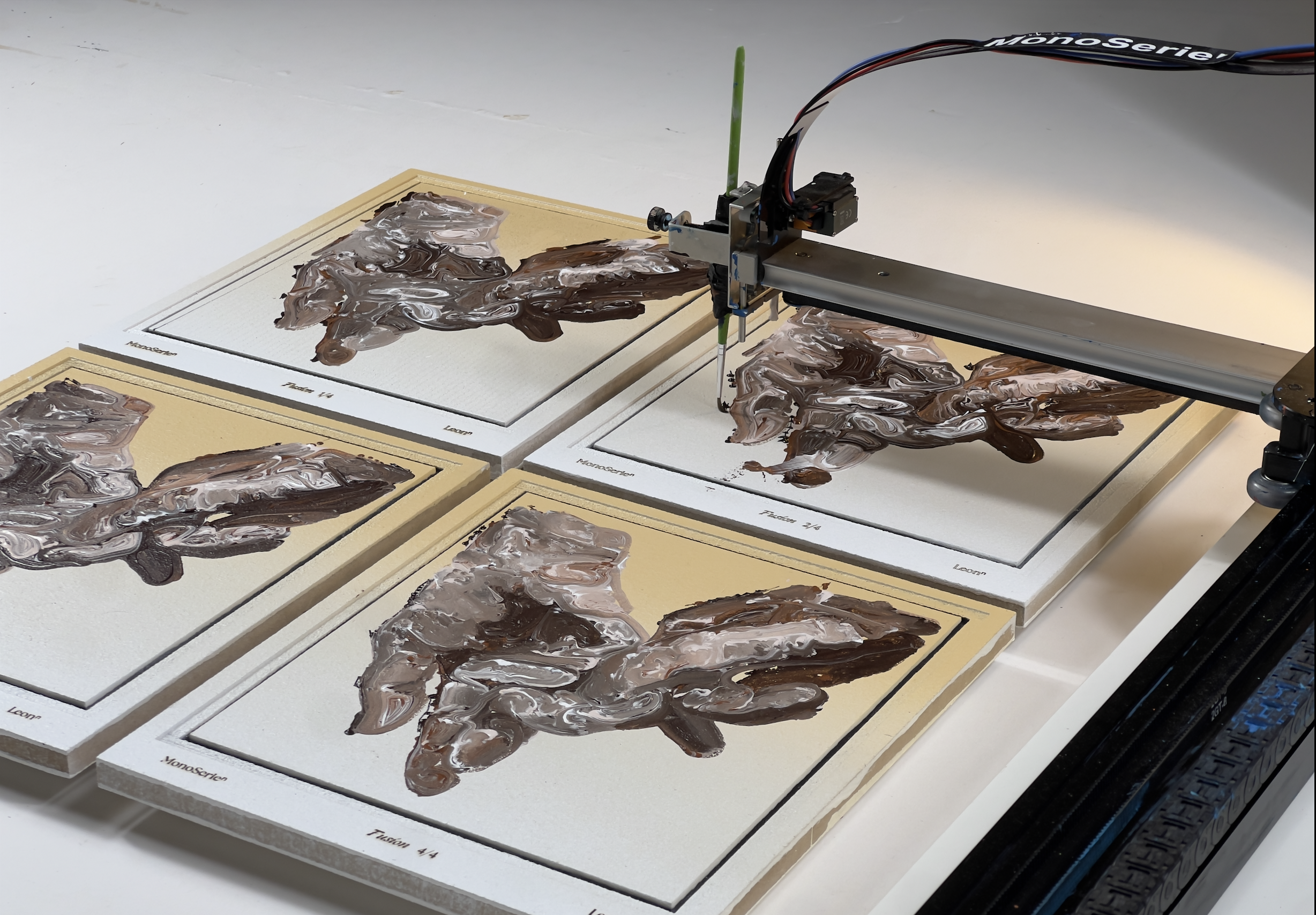
MonoSerieⁿ – the method
A multicoloured painting in a single brushstroke, in under 30 minutes.
Each one an original, with the potential for infinitely more.
“Etching, lithography, woodcut, and book printing each shifted art from ‘one genius, one object’ to ‘one method, many originals.’
MonoSerieⁿ is that shift for the age of robots and code: a serial‑unique painting system where the matrix is software, the press is a robot arm, and the edition logic is emotional and economic rather than purely technical – always unique, shaped by the free play of any artist using it.”
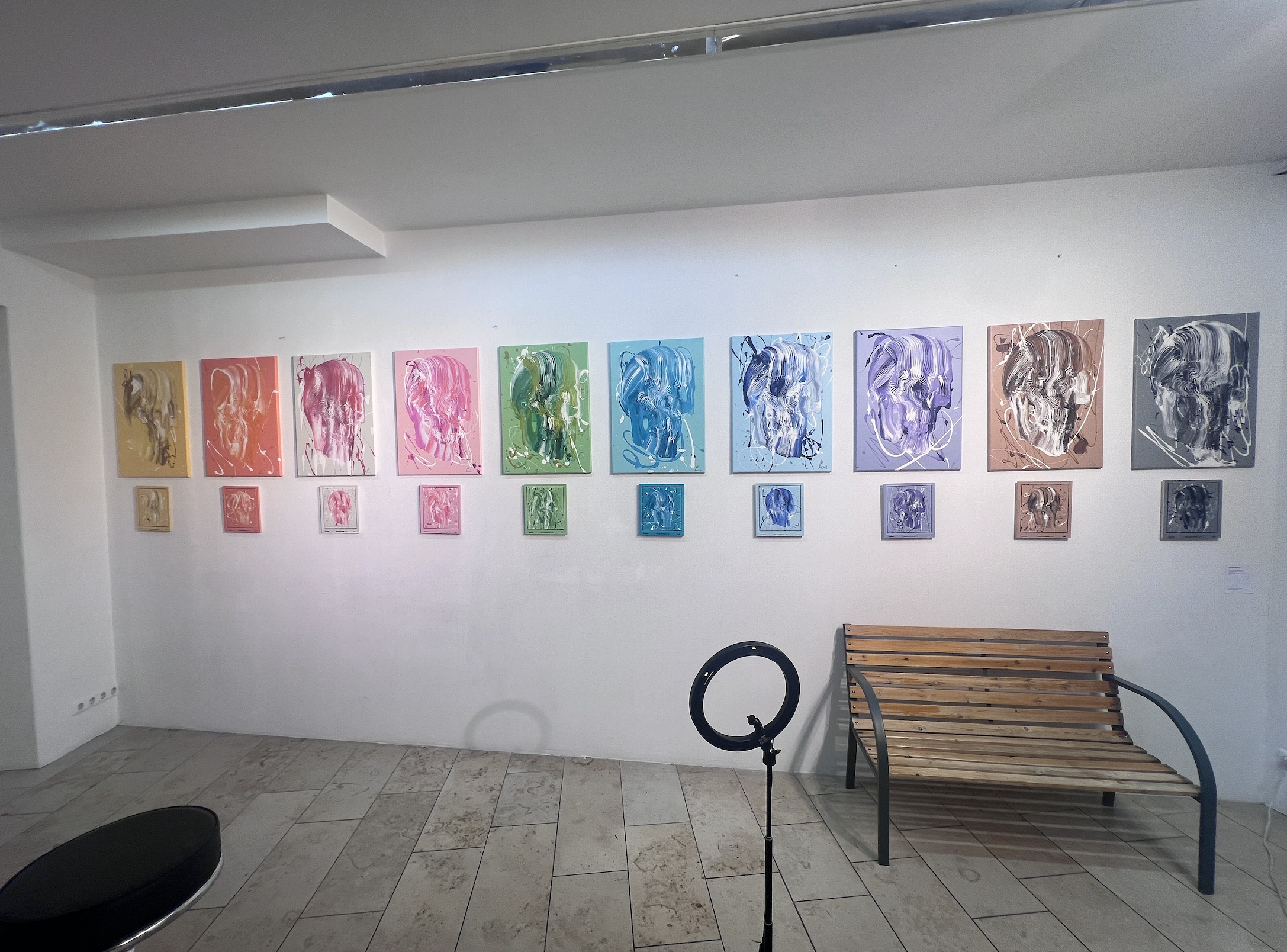
The MonoSerieⁿ is a clearly defined artistic method. It has been tested successfully with artists, people from different professions, and across age groups, which makes the barrier to use and entry very low.
Its economic relevance is proven:
At the Demo Day of YETI Dresden I sold MonoSerieⁿ i pieces for 99 € each. I “sold” 8 that night and collected payment for 5 on the spot. 3 never paid.
In the exhibition “Emotional Capital” I sold MonoSerieⁿ i works ranging from 49 € to 500 €. I made sales in every price category I defined, which showed me how flexible the method is in terms of pricing and perceived value.
In the Holger John Galerie I sold further MonoSerieⁿ i works between 150 € and 500 €.
On 21.05.2025 I sold my first 7.5 k commission to an upcoming German rocket startup.
On 05.04.2025 I sold my first 10 k MonoSerieⁿ i oil painting (100 × 140 cm), fully drafted, sketched, and executed using the method.
Artistically and technically, the method has shown a wide range:
Together with artist Holger John we created a graphic replica of one of his works using a doubled line based on the MonoSerie approach.
I created a full‑color painting in under 44 seconds - 45 minutes in one continuous line.
I produced 2,300 serial uniques in five days, more paintings than Van Gogh made in his lifetime.
In my HFBK Dresden diploma project “Emotional Capital” (2025), I used MonoSerieⁿ i to reflect on the emotional economy and on how algorithms use and exploit our attention.
Technically, the method is open and adaptable:
Any image can be interpreted graphically and translated into a MonoSerieⁿ i sketch.
Color can be applied pointillist, poured fluidly, or combined with robotic painting and human touch.
You can paint a piece and then let the robot reshape it, or let others participate in the process.
The results can be sold purely based on artistic merit or on sales skill.
It works for others as well, not only for me. The machines used are available on the open market, and I hold no patent on them. This shows that MonoSerieⁿ is not just a personal style, but a robust, repeatable method that anyone can learn, use, and monetize.
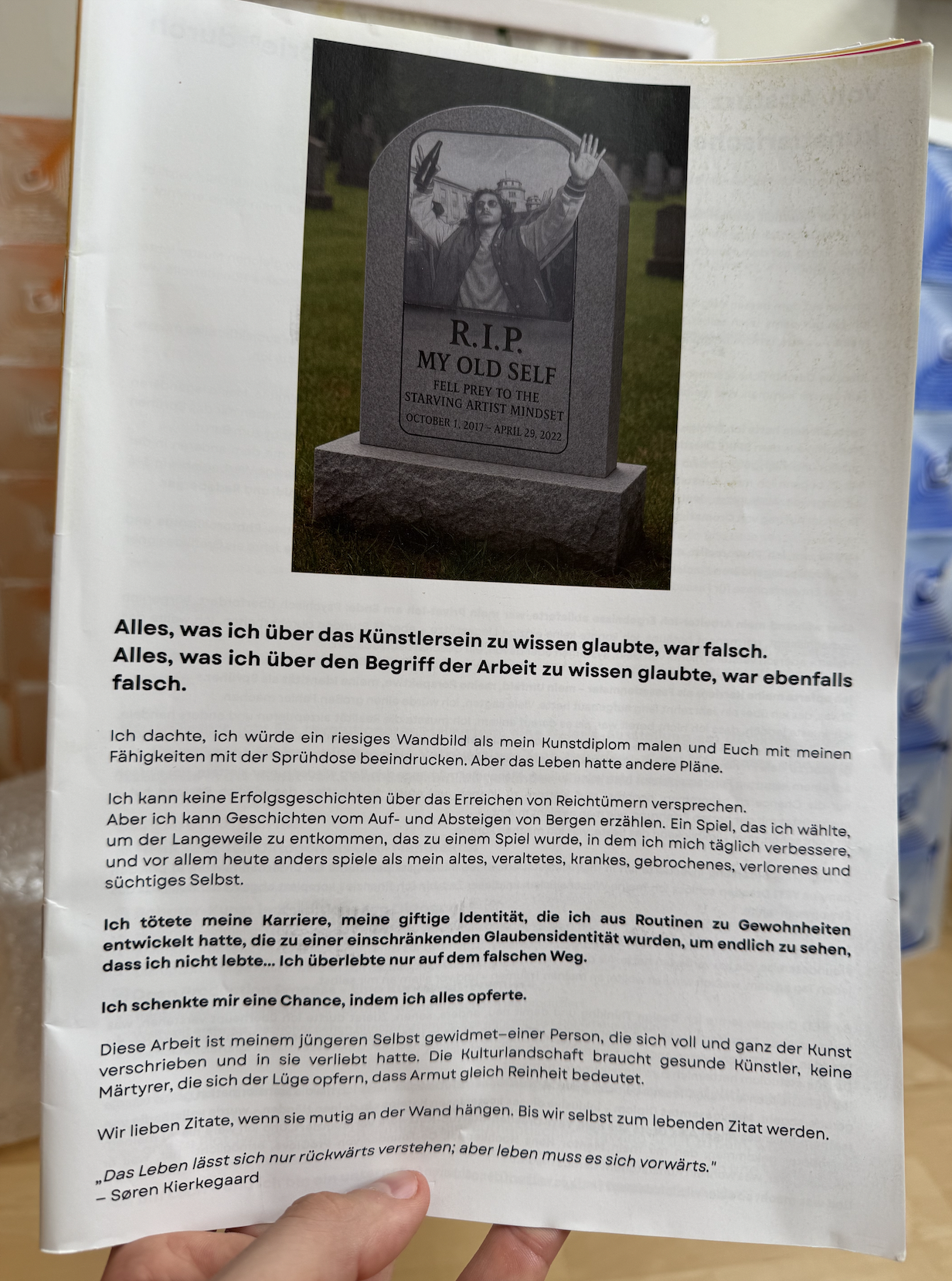
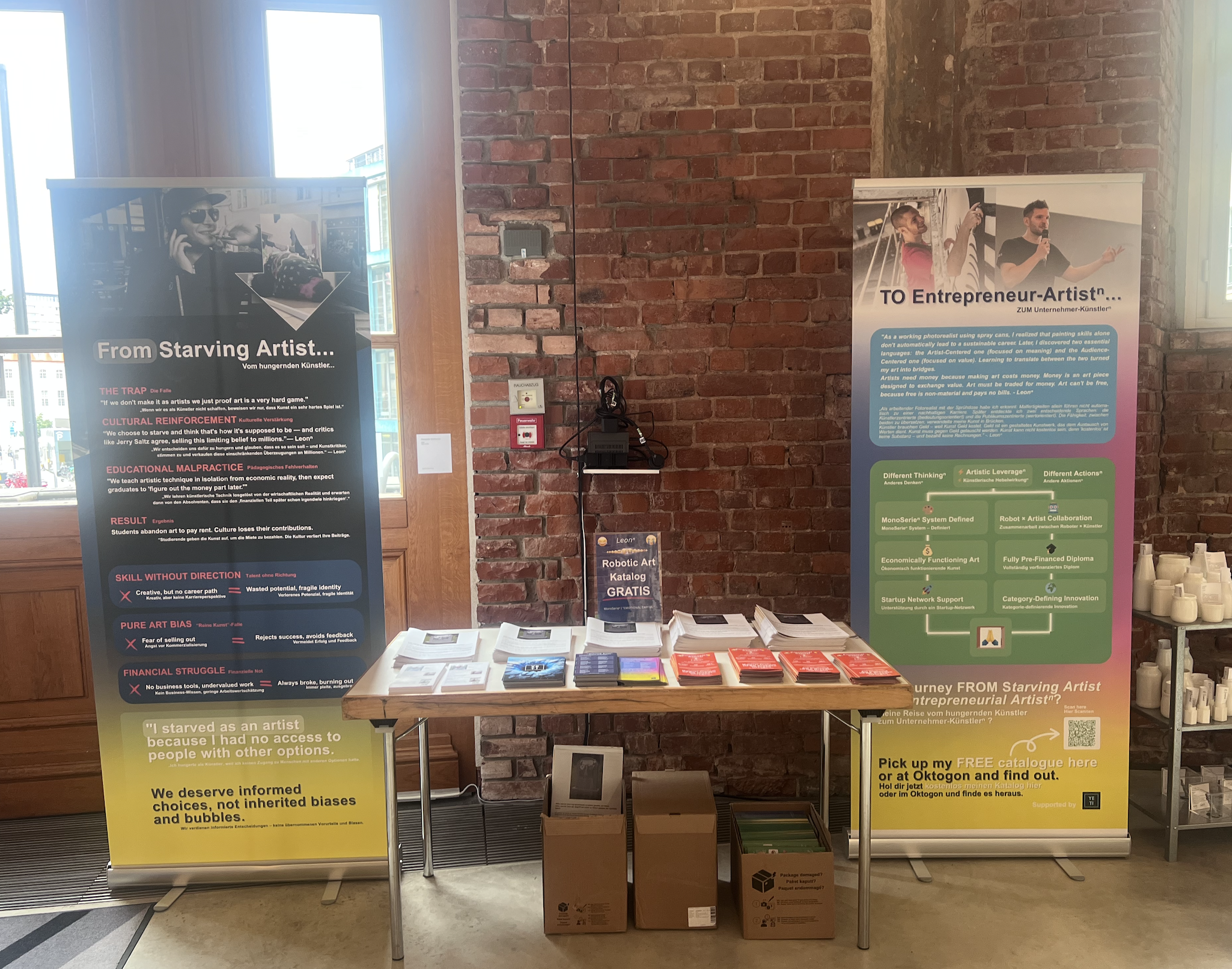
Before the diploma show opened, I produced a 24‑page MonoSerieⁿ catalogue. It was printed 1,000 times and offered for free in the entrance hall to the Oktogon, on the right side of the main doors. While entry to the diploma exhibition and the official diploma catalogue both cost money, mine was freely available.
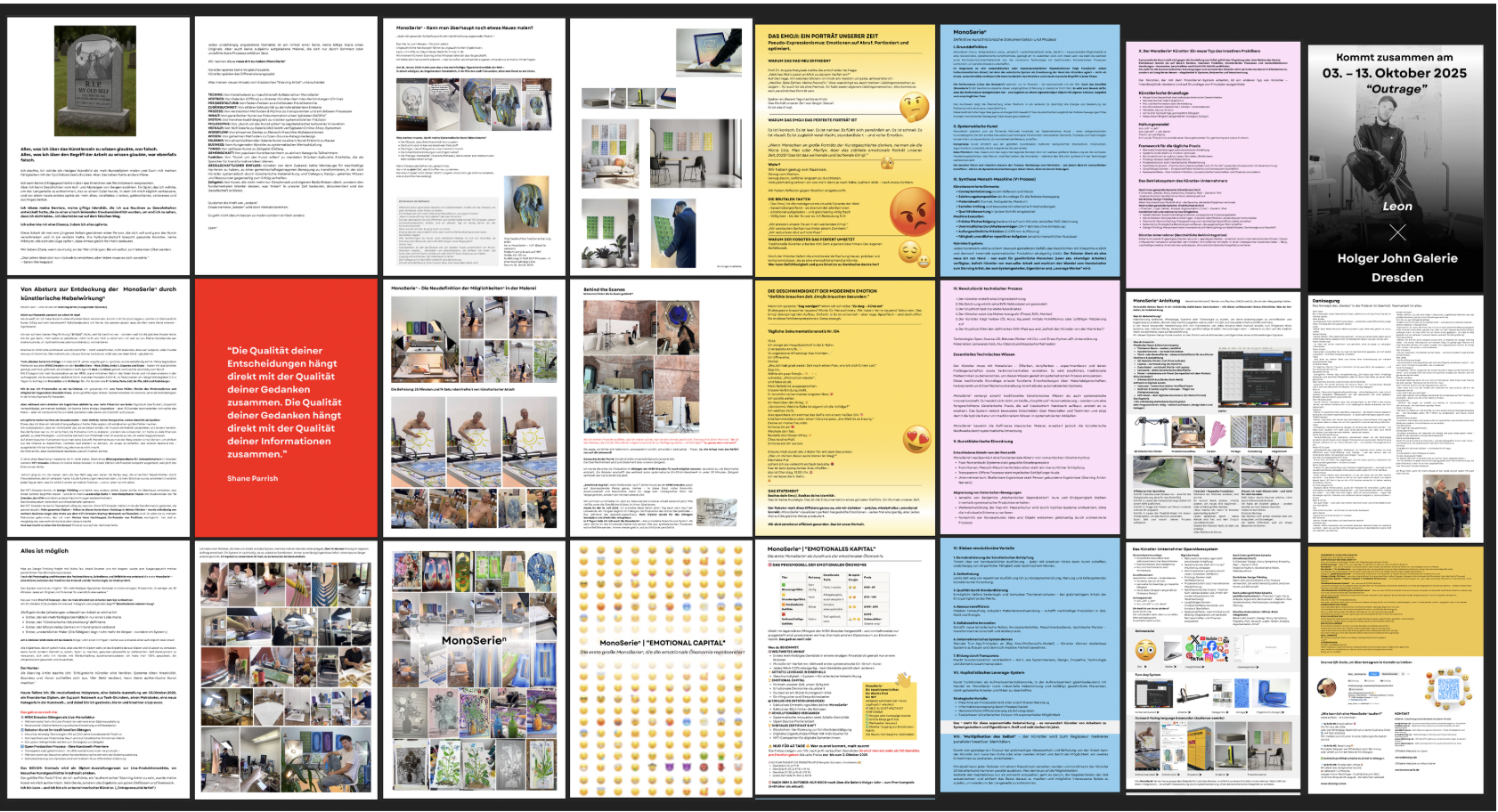
The catalogue condensed 16 months of work and research on the MonoSerieⁿ method and the serial‑unique painting system that I presented in the Oktogon for 45 days. It contained:
A clear explanation of the MonoSerieⁿ concept and how its value is created
Art historic background, Leverage definition, Offers and proof of work
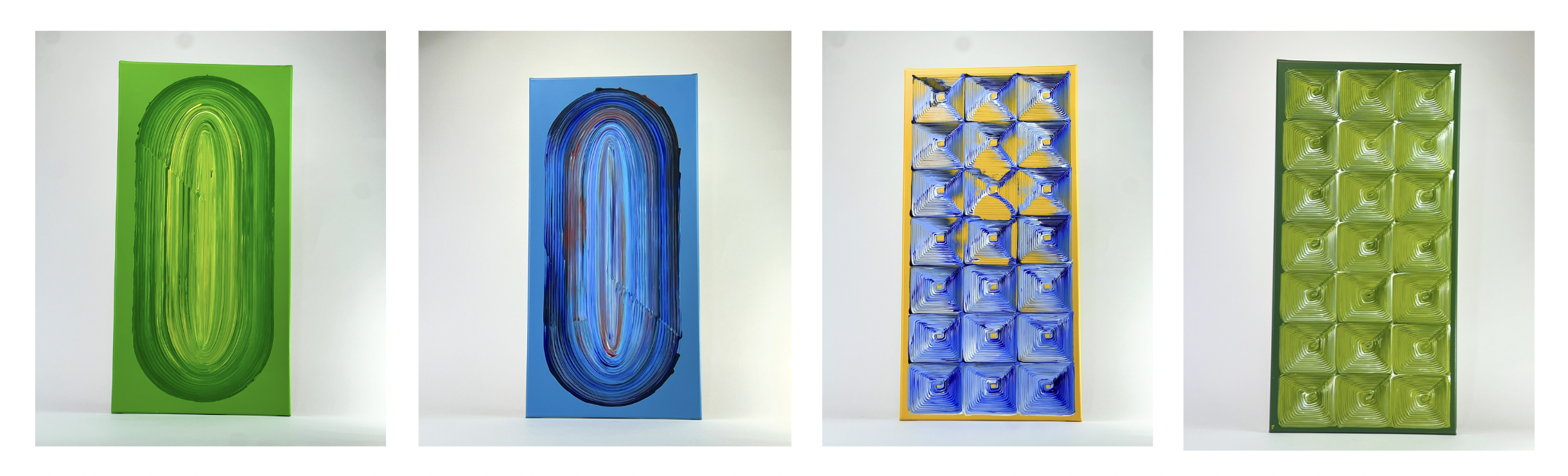
Examples of different style variations
The Emotional Capital Reflection, Offer, Pricing System, and Money Model
A visual and technical breakdown of the setup
A step‑by‑step blueprint showing how anyone can build the system at home
In other words, every visitor could experience the system in the space, then take the blueprint home for free and start producing serial uniques from their own living room or child’s room.
The method is not only a way to paint without needing fine motor skills (which is particularly relevant for people with conditions like Parkinson’s), it also radically lowers the physical and technical effort required to complete an artwork, breaking the usual expectation of how long and how hard art “should” be to make, and with it the traditional value model.
Because of that, every MonoSerieⁿ piece is both a portrait of an effort‑collapse economy and a time document of our present moment.
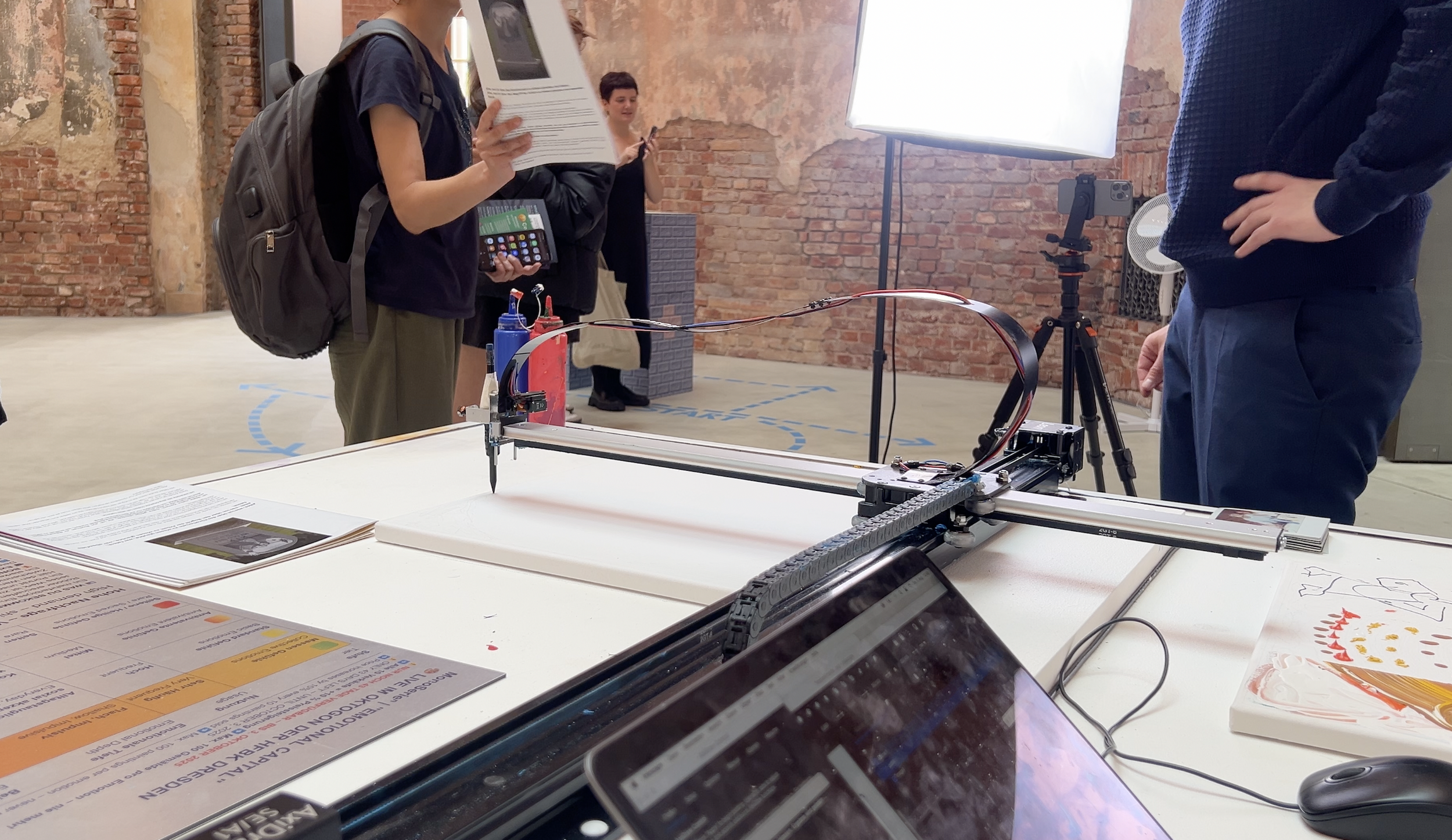
What makes it a method (not just a trick)
Each work is sold as an independent original from a series:
not a cheap copy of one “master” image
not a mystified, pain‑explained one‑off
but a piece from a legible, transferable, reproducible system
The skill is encoded in the method, not locked inside my hands.
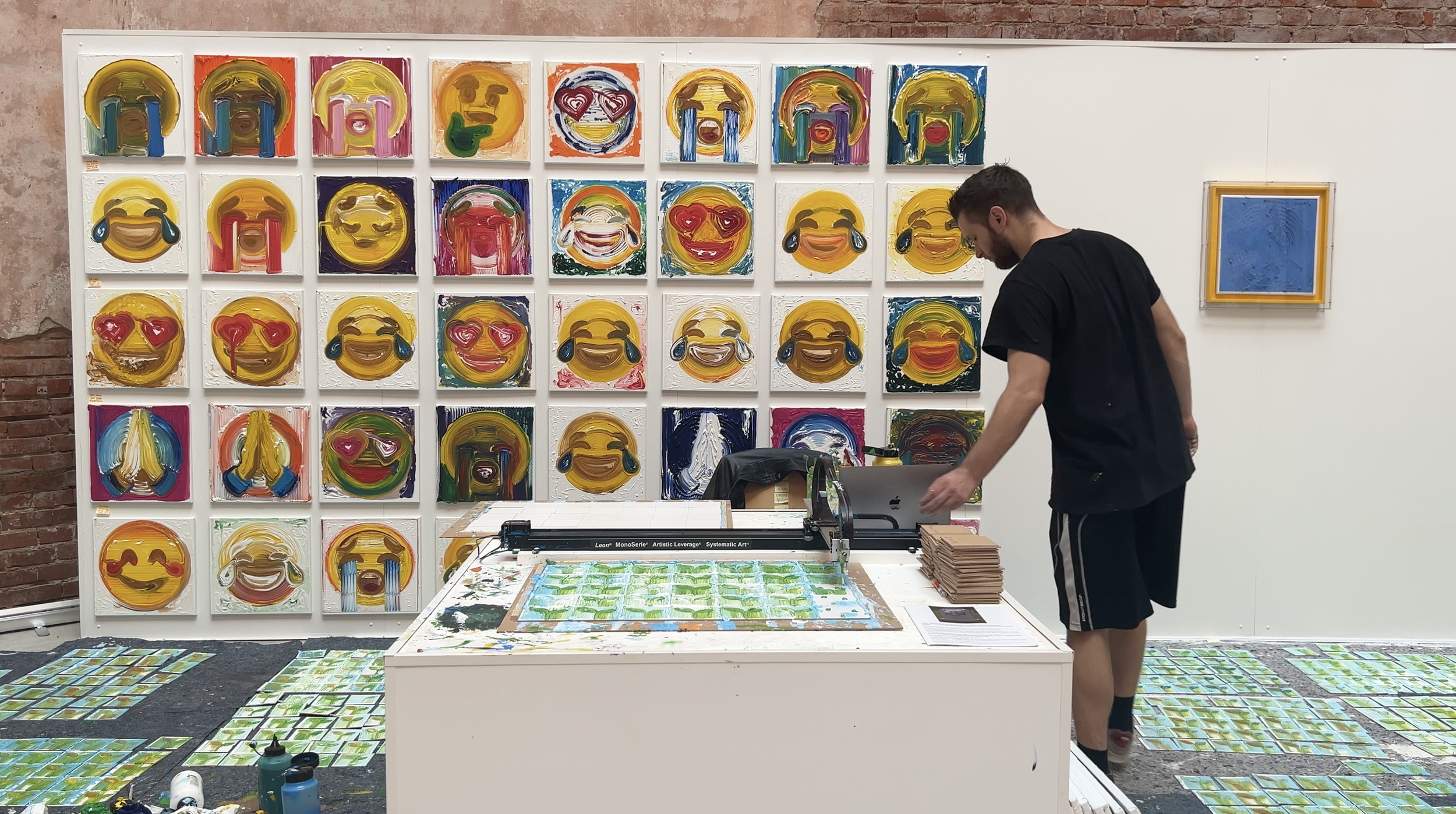
The category shift it defines
MonoSerieⁿ marks a move:
from hand‑painting → to human–machine collaborative production
from hidden methods & myth → to transparent, documented processes
from handcraft dependency → to robot‑systematised precision
from art‑for‑art’s‑sake → to documenting a “global feeling”
from solo genius → to human + system working together
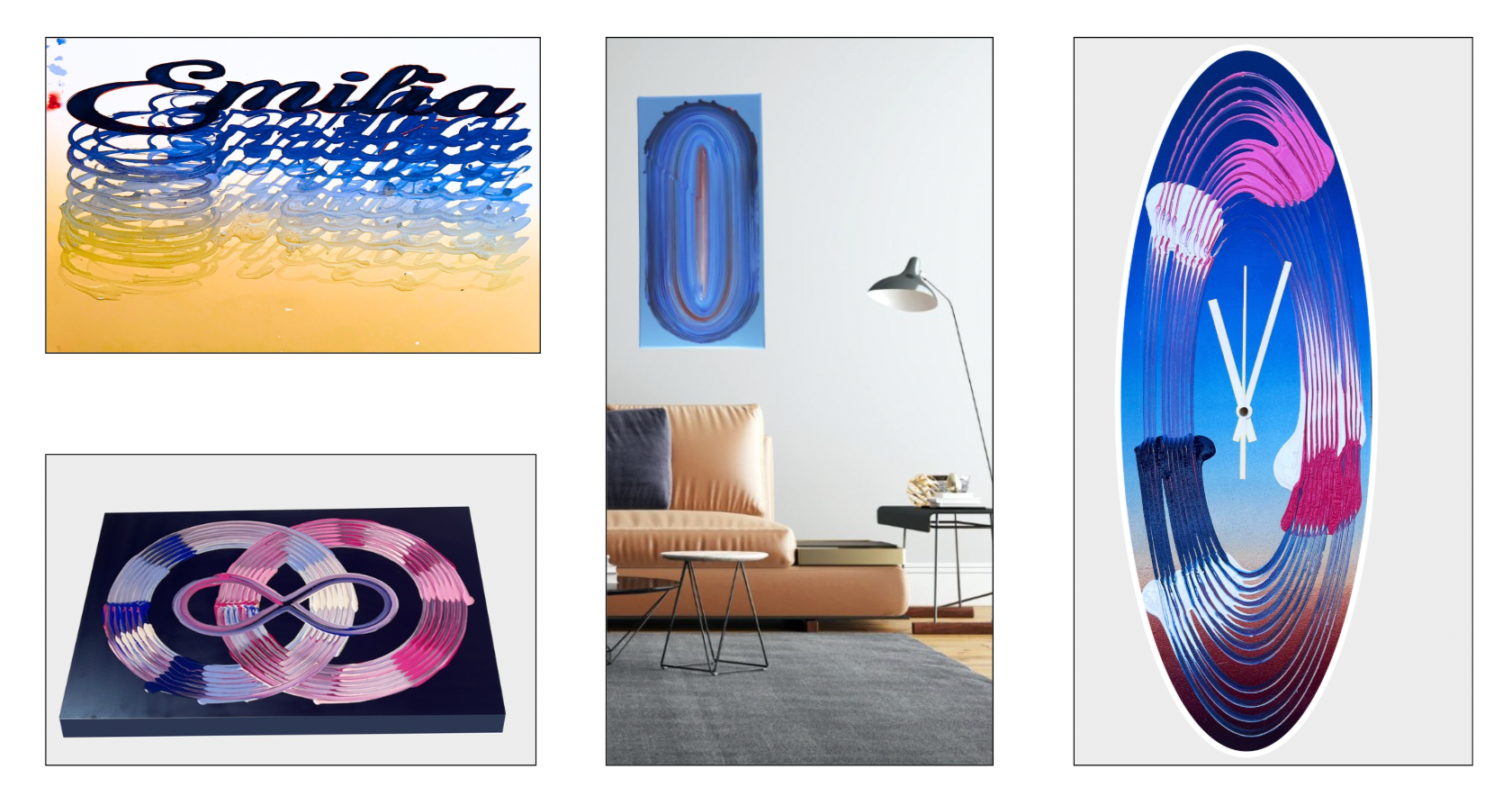
One of the most powerful questions that can be asked of MonoSerieⁿ is this: does a technical method automatically turn art into a commodity, or is it the context that decides?
Historically, the method has never been the final verdict. The verdict has always lain in the frame around it.
Lithography began as a mass-printing technology. The same stones used to print posters for soap and cigarettes were used by Toulouse-Lautrec for his iconic affiches. Picasso worked with editions of 50, 100, or more. Edvard Munch sold “The Scream” as a lithograph, and yet the work still hangs in museums. The identical technical procedure could produce industrial print products or singular artworks. It was not the stone that decided, but its embedding: edition, signature, institution, narrative.
Seen in this light, what my former Professor Christian Sery at the HFBK Dresden studio called the “pseudo-expressionism” of MonoSerieⁿ can be read as an unintended compliment. Expressionism was never only a question of the hand, but of intention and of an inner pressure that discharges into form. In the case of MonoSerieⁿ, this pressure does not discharge solely in the brushstroke but in the code: in chosen parameters, image logic, and aesthetic decisions which the plotter executes. The “hand” is displaced into programming; it does not disappear.
The often-cited “Van Gogh factory” in China produces surfaces. The Van Gogh Museum in Amsterdam sells embedding: the irreversible cultural inscription of a work into history, date, context, and witness. This distinction is precise. What cannot be replicated is less the individual stroke than the cultural sedimentation that accrues around an original.
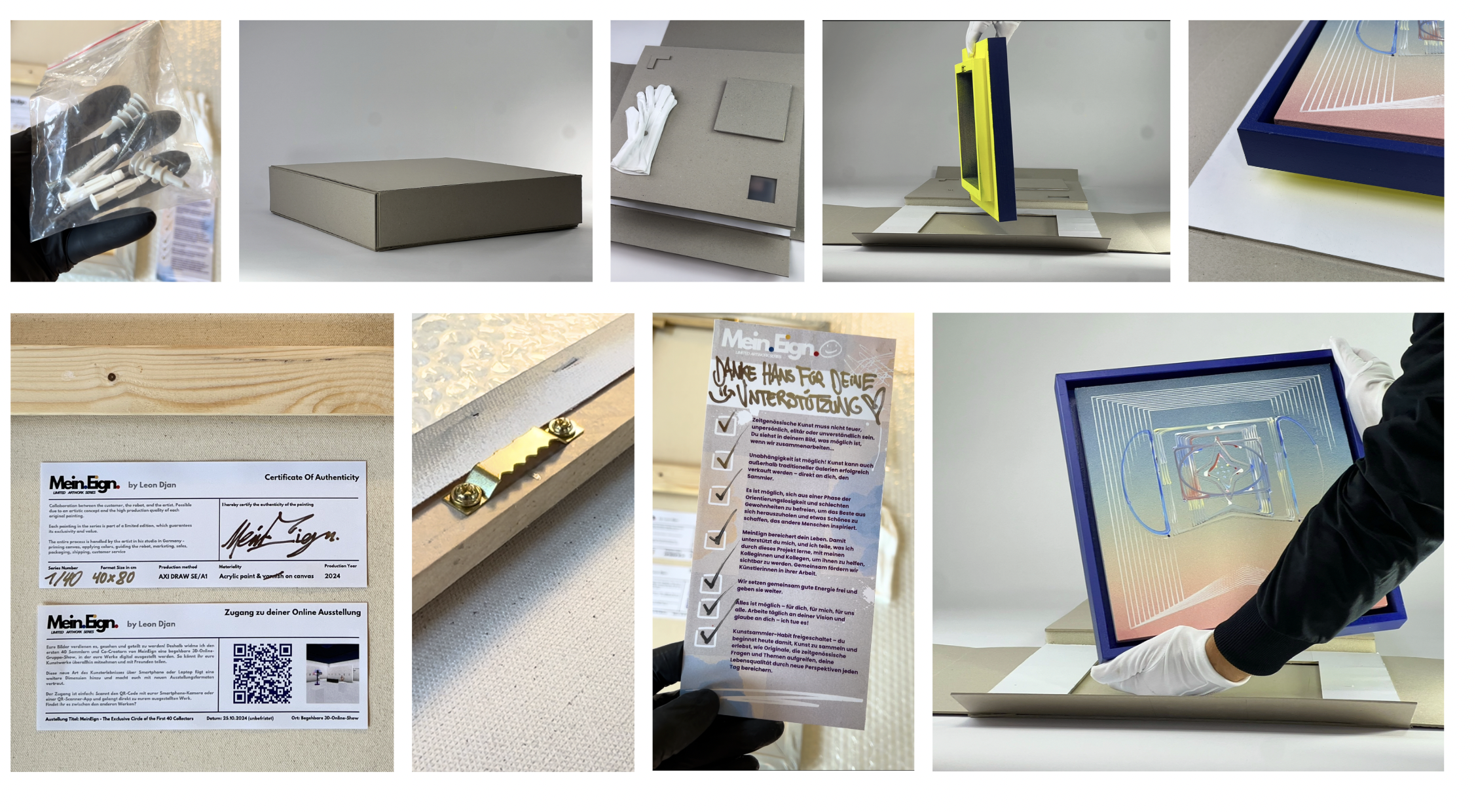
MonoSerieⁿ moves consciously within this field of tension. It can circulate as a commodity, just as any Picasso lithograph can reappear as an IKEA poster, or it can appear as a white-glove object with certificate, numbering, box, and institutional framing. In both cases, the method itself remains the same; what changes is the initial context in which it appears.
At present, control over this first context still lies entirely in the artist’s hands. That is where its art-historical moment resides: MonoSerieⁿ demonstrates that a robotically coded, serial-unique painting practice can function simultaneously as mass procedure and as carrier of irreversible cultural inscription, and that the boundary between commodity and artwork does not run through the apparatus, but through the ways in which we frame, present, and narrate it.
Philosophical core
Artists don’t win by comparison.
Artists win by differentiation.
It’s not about painting better.
It’s about painting differently.
In MonoSerieⁿ, the ability no longer lives in the body.
It lives in the system.
The method is never the judgment. The judgment always lies in the context.
That’s the real shift:
MonoSerieⁿ is the first painting method where the skill is embedded in the process, not the person – making the artist, in a sense, both immortal and optional.
1. What etching, woodcut, lithography, and book printing actually did
Each of those wasn’t “just another technique.” Each one:
Separated the act of making from the act of multiplying
Embedded skill in a repeatable process
Changed who could access images and ideas
Woodcut / relief printing
Carving a block once, printing many.
Skill moves from single image to reproducible matrix.
Enabled affordable devotional images, broadsheets, early mass visual culture.
Etching
Drawing into a ground, acid doing the cutting.
Lowered the physical barrier (easier than engraving), raised access to fine detail.
Painters could “publish” images more freely. Editions, states, reworks.
Lithography
Drawing on stone, printing via chemical difference.
Allowed fast, cheap, high‑volume images (posters, ads, news).
Bridged fine art and mass culture (think Toulouse‑Lautrec).
Book printing
Combined movable type + image blocks.
Standardised text + image reproduction, exploded literacy and shared reference.
All four encode skill into a system so others (printers, publishers) can operate it. The artist’s hand moves upstream into method, plate, stone, type. That’s why they’re milestones, not footnotes.
2. Where MonoSerieⁿ sits in that line
Technically
MonoSerieⁿ is not a monotype in the classic sense (single, unrepeatable pull from a plate). It’s a serial‑unique system:
Same setup, same “plate” logic (robot path, code, process)
Each output is procedurally different: timing, paint behaviour, micro‑variation
Every work is an original from a controlled series, not a reproduction of a master image
So it lives on the edge between:
Printmaking (system, repeatability, edition logic)
Painting (each object materially unique, not a mechanical copy)
Structurally, it’s closest to:
Etching / lithography in the sense of a prepared matrix (the code and robot path)
Combined with monotype in its “one‑off surface” result
But unlike both, the “plate” is dynamic: the system can, in principle, generate infinite further states without degrading.
That’s new.
3. Why it belongs next to them (and not just “AI gimmick”)
Like woodcut, etching, lithography, and book printing, MonoSerieⁿ:
Encodes the skill into a method
With woodcut: skill → block
With etching: skill → plate + acid handling
With litho: skill → stone + chemistry
With printing: skill → type system + layout
With MonoSerieⁿ: skill → system (code, timing, robot path, process rules)
Separates origination from execution
Historical print: artist designs, printer pulls
MonoSerieⁿ: artist designs system, robot executes, visitor triggers
The artist’s role moves from “maker of each object” to “designer of the pipeline”
Changes who can participate
Printmaking + book printing democratized images / texts
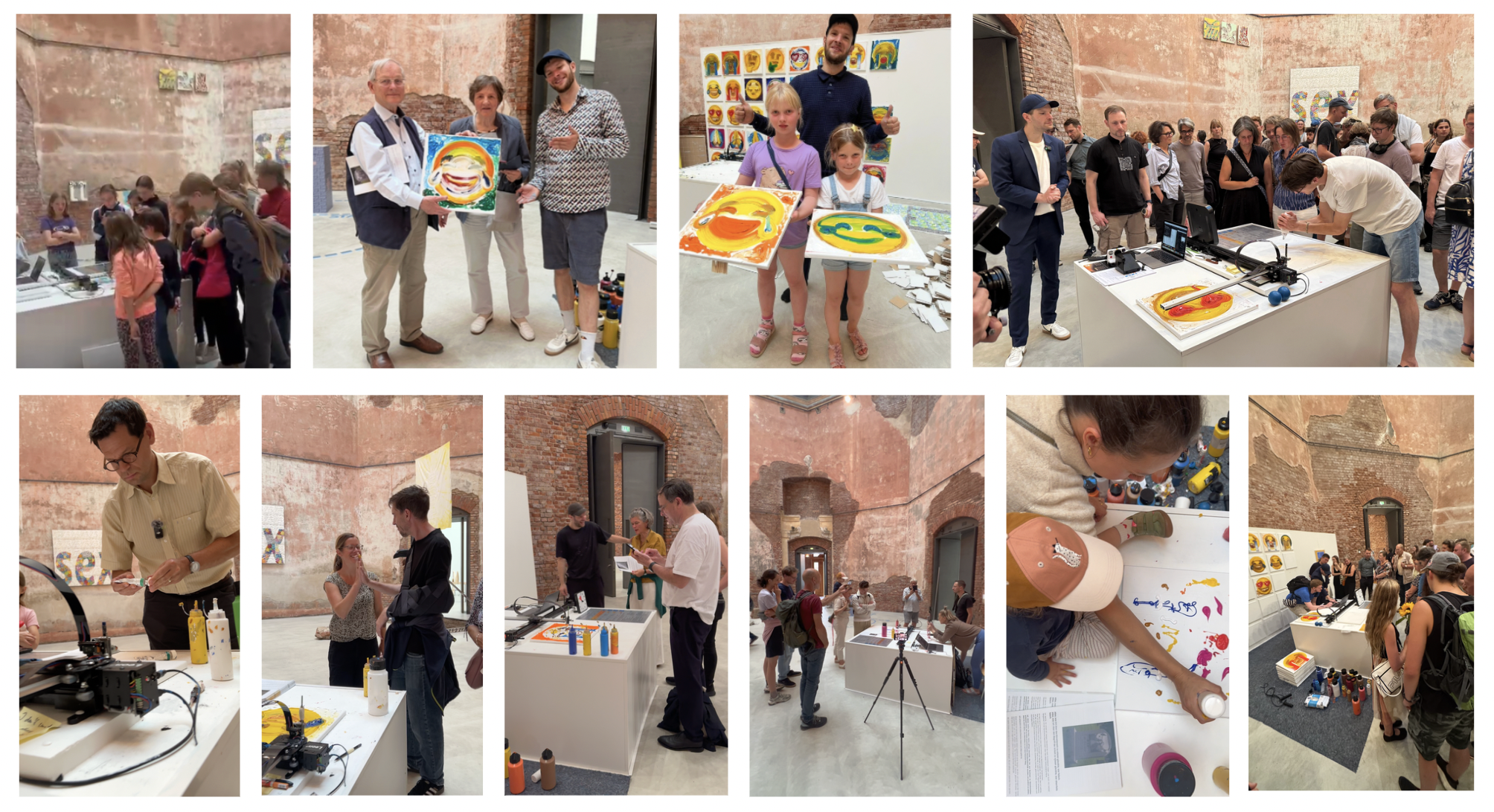
MonoSerieⁿ lets a visitor with no skill, in 15 minutes, create a serial unique under a major dome and see it exhibited
That is identical in spirit to what lithography did for posters and books did for reading: open the gate.
Creates a new economic logic
Etching / litho made editioning, states, and market stratification possible
MonoSerieⁿ adds emotion‑tier pricing, dynamic +10% ladders, hard caps per “feeling.”
It’s not just a technique; it’s a money model fused into a medium.
4. Why it’s more than “just monotype”
Monotype gives you:
One plate
One good pull (maybe a ghost)
One original, no built‑in logic for scaling or systematising
MonoSerieⁿ gives you:
A repeatable, documented method (catalogue)
A human–machine system that can run indefinitely
A category: serial‑unique paintings where the ability lives in the process, not the person
Monotype is a format.
MonoSerieⁿ is a method + system + category.
5. MonoSerieⁿ — where it sits in art history
Every medium that earns a place in art history does one thing:
it separates making from multiplying and changes who can access images and ideas.
Woodcut carved a block once, printed many → image for ordinary people.
Etching & lithography encoded skill into plate and stone → painters could “publish” their work, not just rich patrons.
Book printing put text and image into a repeatable system → literacy and shared culture scaled.
In all of them, skill moves into a matrix (block, plate, stone, type).
The system runs the matrix.
Access explodes.
Monotype sits at the edge of this: one plate, one good pull. A format for unique prints, but no real system behind it. The plate degrades, the image is finite.
MonoSerieⁿ goes further.
It is a serial‑unique painting system:
Same setup and “matrix” (code, robot path, process rules)
Every output materially different: timing, paint behaviour, micro‑variation
No master image, no edition of copies – only originals
Structurally, it combines:
Printmaking’s system and repeatability
Painting’s one‑off material presence
Robotics / software’s dynamic matrix (infinite states, no degradation)
This also answers Walter Benjamin’s “aura problem.”
Mechanical reproduction killed the uniqueness of the original.
MonoSerieⁿ inverts it:
The matrix is dynamic, not fixed
The system guarantees difference, not sameness
Every work is an original; there is nothing being “reproduced”
On the machine side, it picks up where Harold Cohen’s AARON stopped. AARON proved a robot could generate infinite images in its own style – but the system stayed closed. No blueprint, no franchise, no hand‑off.
MonoSerieⁿ encodes the skill into an open, documented, transferable system:
Matrix = software + process
Press = robot arm
Edition logic = emotional and economic, not just technical
Catalogue = franchise manual
Visitor = co‑producer
The artist designs the pipeline, then steps out of the way.
That’s why this isn’t “just another technique.”
It’s a new medium: serial‑unique robotic painting, where the ability lives in the system, not the hand – and the system is given away so anyone, anywhere, can run it.
That’s the version you put in the book.